
The Hidden Economic Messages in Renaissance Art

Anúncios
Hidden Economic Messages in Renaissance Art explain how the era’s greatest masterpieces served as sophisticated financial ledgers for Europe’s elite merchant dynasties and bankers.
Beyond religious piety, these canvases functioned as high-stakes marketing tools, broadcasting wealth, global trade connections, and the immense creditworthiness of their ambitious patrons.
Mastering the visual language of the 15th century reveals that painters were essentially visual auditors for the Medici and Fugger families.
Every pigment choice and textile fold signaled deep liquidity, ensuring that family legacies remained etched in the public’s collective financial memory.
Decoding Visual Capital
- Pigment Portfolios: How expensive minerals like Lapis Lazuli acted as a physical display of liquid assets on chapel walls.
- Textile Credit: The role of complex black dyes and luxury furs in signaling a merchant’s elite standing and trade access.
- Global Logistics: Identifying exotic fruits and Oriental rugs as proof of a patron’s mastery over dangerous international supply chains.
- Laundering Reputation: Using sacred art to offset the social stigma of usury while projecting immense cultural and political soft power.
How did material costs define the value of art?
Hidden Economic Messages in Renaissance Art often reside in the raw cost of materials, where the pigment price frequently surpassed the artist’s fee.
Anúncios
Patrons demanded specific high-cost minerals to ensure their spiritual “investments” looked as expensive as their real-world banking empires.
Lapis Lazuli, imported from distant Afghanistan, created a blue more radiant than any other, reserved strictly for the most solvent customers.
This choice informed the public that the donor possessed the logistical reach to source materials from the farthest corners of the Orient.
Why was Ultramarine a financial flex?
Ultramarine was literally worth its weight in gold, making it the ultimate 15th-century status symbol for the ruling merchant class.
By funding a fresco drenched in this blue, a banker proved he could withstand massive overhead costs without blinking an eye.
This pigment functioned like a modern luxury watch, instantly recognizable to peers as a sign of extreme, unshakeable wealth and stability.
It transformed a simple religious scene into a loud, undeniable statement of the donor’s current financial health and global reach.
++ The Curious Case of Countries That Printed $0 Bills
What did “Luxury Black” signal to rivals?
Producing a deep, consistent black dye was one of the most expensive and technically difficult chemical processes of the Renaissance period.
Wearing black in a portrait wasn’t about mourning; it was about showcasing the ability to afford the most premium textiles.
Saturated blacks required multiple baths in high-grade dyes that often came from specialized trade guilds with exclusive, high-cost manufacturing rights.
Consequently, a “simple” black robe in a painting was actually a sophisticated signal of elite guild connections and massive disposable income.
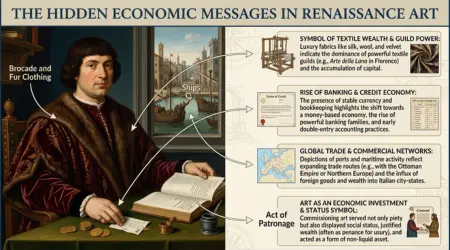
How did trade symbols broadcast mercantile power?
Successful Hidden Economic Messages in Renaissance Art relied on portraying objects that proved a patron’s dominance over volatile international trade routes.
Seeing a Flemish tapestry or a Turkish rug in a Florentine painting signaled a mastery of cross-border logistics and diplomacy.
These items acted as visual certificates of deposit, assuring viewers that the family’s wealth was backed by tangible, high-value global commodities.
In an age of frequent bank failures, displaying these goods built the trust necessary for securing future loans and political favors.
Also read: When a Bank Robbery Led to the Invention of Bulletproof Finance
Why were oranges a sign of wealth?
In Northern Europe, displaying fresh oranges in a painting like the Arnolfini Portrait was a staggering display of logistical and financial prowess.
These fruits required climate-controlled shipping and rapid transport from the Mediterranean, proving the patron controlled the fastest supply lines.
Such perishable luxuries served as the Renaissance version of a private jet, showing that the owner moved faster than the common market.
This “hidden” message told rivals that the Arnolfini family were masters of time, distance, and the high-tech shipping of 1434.
Read more: The Real Cost of a Medieval Knight — In Today’s Dollars
How did rugs represent banking networks?
Oriental carpets were massive capital investments that linked European living rooms to the exotic wealth of the Ottoman Empire’s most lucrative markets.
Including one in a portrait signaled that the merchant had the diplomatic “keys” to trade in territories where others feared to tread.
Rugs were often passed down as family assets, much like stock portfolios, representing a diversified collection of rare and durable international wealth.
They provided a stable, tactile foundation for the family’s public image, suggesting a net worth that spanned across multiple continents and currencies.
Why did bankers use religious art as a hedge?
The inclusion of Hidden Economic Messages in Renaissance Art often helped financiers navigate the dangerous moral landscape of 15th-century Catholic Europe.
Since “usury”charging interest was technically a sin, massive art donations served as a form of spiritual and social debt restructuring.
By paying for grand cathedrals, bankers “laundered” their reputations, turning potentially dirty money into divine beauty that benefited the entire local community.
This was a strategic trade: gold for salvation and, more importantly, for the continued political support of the Church and the masses.
How did the Medici “audit” their image?
The Medici family frequently appeared in religious scenes, effectively “auditing” their place in the social hierarchy alongside saints and holy figures.
This visual proximity to the divine suggested that their immense banking fortune was sanctioned by God Himself, discouraging any public dissent.
They used art to negotiate political loans, treating a commissioned masterpiece as a down payment on future legislative influence and papal favors.
Their collection was a functional extension of their ledger, where every painting had a specific, calculated ROI in terms of power and prestige.
What is the ROI of cultural patronage?
Strategic patronage built a “soft power” moat that protected banking families from the physical violence of disgruntled debtors or rival political factions.
A family that provided the city with its most beautiful landmarks was much harder to exile or execute during times of crisis.
This investment in beauty created a brand loyalty that modern corporations would envy, turning common citizens into stakeholders of the family’s success.
It was the ultimate long-term hedge, ensuring that even if the bank failed, the family’s cultural capital remained untouchable and legendary.
Material Value & Economic Signifiers
| Feature | Material / Symbol | Economic Meaning | Estimated Cost (Rel.) |
| Pigment | Lapis Lazuli (Ultramarine) | Global Supply Chain Mastery | Extremely High |
| Textile | Deep Black Dyed Velvet | Elite Guild Membership | High |
| Fruit | Mediterranean Oranges | Rapid Logistics Control | Medium-High |
| Object | Oriental Rugs | International Trade Networks | High |
| Location | Family Chapels | Social Debt Restitution | Massive |
The sheer brilliance of Hidden Economic Messages in Renaissance Art lies in their ability to hide complex financial data in plain sight.
According to research from the University of Leicester (2025), art patronage accounted for up to 10% of a merchant’s total annual expenditure during peak years.
Think of a Renaissance painting as a modern corporate website; it tells a story, but its true purpose is to close the next big deal.
Is your perception of these classic works changed now that you see the price tags hidden behind the halos?
Every canvas from this golden age is a window into a world where beauty was the most effective currency available.
We are finally learning to read the math of the masters, proving that art and finance have always been two sides of the same coin.
As we look at these works in 2026, they remind us that the pursuit of wealth has always required a touch of creative genius to survive.
The message is clear: true power is not just held in a vault, but displayed for all to see and admire.
Does the “hidden” wealth in these paintings make them more or less beautiful to you? Share your experience in the coments!
The Legacy of the Canvas Ledger
The study of Hidden Economic Messages in Renaissance Art confirms that the history of creativity is also the history of capital.
By understanding the fiscal motives of the past, we gain a clearer vision of how value is constructed and communicated in our own modern world.
Frequently Asked Questions
Why was Lapis Lazuli so expensive?
It could only be mined in one region of Afghanistan, requiring a dangerous, multi-month journey across several borders and hostile territories to reach Europe.
Did artists know they were painting “economic messages”?
Absolutely; artists often signed contracts specifying exactly which pigments and materials they had to use to satisfy the patron’s financial ego.
What was the “sin of usury”?
In the Renaissance, charging interest on loans was considered a grave sin, forcing bankers to use art as a way to “repay” their spiritual debt.
How do we know the costs of these materials today?
Historians use preserved merchant ledgers and guild records that meticulously detail the prices of dyes, minerals, and imports from that specific time period.
