
The History of Stock Exchanges: From Coffee Houses to Algorithms
Anúncios
The history of stock exchanges reveals how human ingenuity transformed informal trade gathering spots into ultra-fast digital marketplaces driving global wealth creation today.
Modern financial systems depend entirely on these organized venues, where capital flows seamlessly between ambitious corporations seeking expansion and forward-looking investors targeting solid financial growth.
Understanding this evolution helps investors navigate current market dynamics with greater clarity, historical perspective, and tactical awareness across diverse global asset classes.
Throughout centuries of rapid economic expansion, trading practices shifted dramatically from physical floor hand gestures to complex automated trading algorithms executing transactions within microseconds.
Key Highlights of This Guide
- The Foundations of Global Capital Markets: How early Venetian debt trading and Amsterdam spice routes created structured public equity trading.
- From Informal Coffee Houses to Floor Trading: The emergence of Jonathan’s Coffee House, the Buttonwood Agreement, and regulated physical trading pits.
- The High-Speed Algorithmic Era: How electronic execution networks, dark pools, and automated high-frequency algorithms now drive global liquidity.
- Comparative Milestones Overview: A detailed analytical table charting the evolutionary transformation of securities exchanges through major historical eras.
- Frequently Asked Questions: Clear answers to essential questions regarding exchange architecture, modern algorithmic execution, and market regulation.
What Triggered the Emergence of Early Financial Markets?
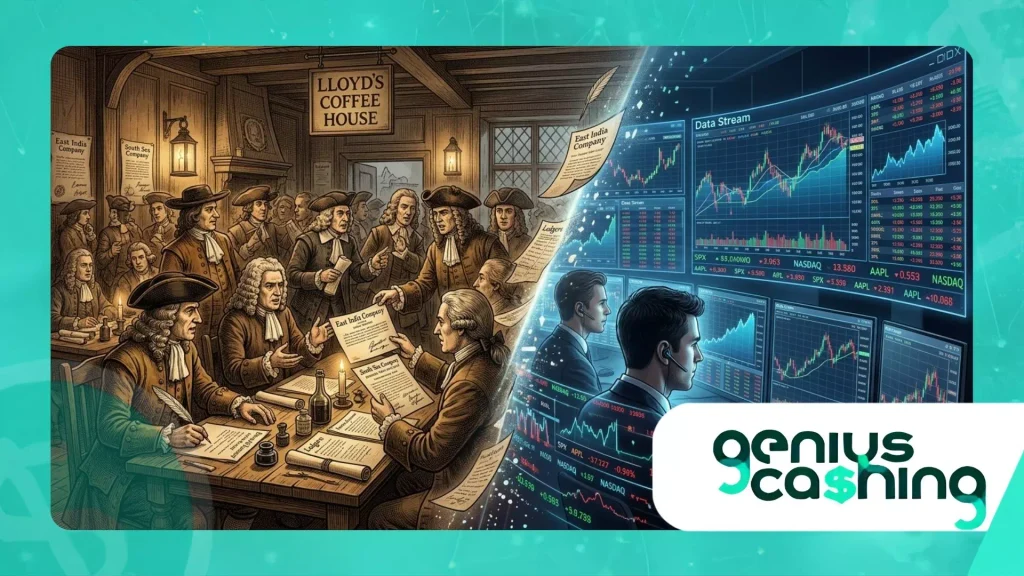
How Did Antwerp and Amsterdam Invent Modern Public Equity Trading?
Merchant guilds during the 16th century met regularly on merchant bourses across Antwerp and Bruges to negotiate informal debt contracts and shipping bills of lading.
Anúncios
However, the Dutch East India Company revolutionized global corporate finance in 1602 by issuing shares of stock to share maritime risk while financing costly oceanic trade voyages across Asian shipping routes.
This groundbreaking decision established the Amsterdam Stock Exchange, enabling ordinary citizens to trade public equity securities freely while establishing secondary market liquidity.
Investors quickly recognized that liquid public markets allowed capital redeployment without disrupting long-term corporate operations or maritime expeditions.
The history of stock exchanges demonstrates how secondary trading transformed illiquid private debt into tradable, standardized wealth instruments.
Dutch trading mechanisms introduced options contracts, short selling techniques, and margin trading strategies, establishing core market mechanics still utilized by modern global financial institutions today.
Why Did London Traders Move Securities Bargains into Coffee Houses?
London stockbrokers during the late 17th century operated informally within Jonathan’s Coffee House after being expelled from the Royal Exchange for unruly behavior and speculative noise.
Royal Exchange officials resented aggressive equity brokers competing alongside traditional commodity merchants, forcing stock jobbers to congregate around coffee tables in Change Alley to trade government debt and corporate stock certificates.
Jonathan’s Coffee House quickly developed price lists, standardized transaction rules, and organized trading rosters to establish credibility among private investors.
These informal coffee house gatherings eventually led to the formal founding of the London Stock Exchange in 1801, establishing clear membership qualifications and ethical governance standards.
Financial news circulars distributed across London coffee houses provided transparent bid-ask spreads, allowing investors to evaluate risks accurately before executing equity transactions.
This historic shift from informal social houses to self-regulated institutions laid the structural blueprint for modern financial exchanges across Western Europe and North America.
++ How Aging Populations Influence Future Investments Trends
What Made Wall Street the Dominant Global Financial Trading Hub?
American stock trading began under a shady buttonwood tree on Wall Street in 1792, where 24 prominent brokers signed the historic Buttonwood Agreement.
These pioneering financial brokers established fixed commission rates and pledged exclusive trading privileges among members, preventing chaotic off-market transactions while promoting market orderliness across New York City.
The New York Stock and Exchange Board was formally organized in 1817, introducing structured daily trading sessions for bank stocks, government bonds, and early canal infrastructure bonds.
By the mid-19th century, rapid industrialization, transcontinental railway construction, and manufacturing expansion drove unprecedented demand for public equity and bond capital across the United States.
New York surpassed regional financial markets in Philadelphia and Boston through superior transaction volume, strict listing requirements, and early technological adoption like telegraph networks.
The history of stock exchanges reached a major turning point as Wall Street solidified its status as the world’s premier financial center for capital allocation.
How Did Industrial Innovation Transform Physical Trading Floors?

Why Was the Ticker Tape Revolution Essential for Real-Time Price Discovery?
Edward Calahan introduced the stock ticker machine in 1867, instantly transmitting equity stock prices over telegraph wires directly to brokerage offices across the country.
Before ticker tape technology, remote investors waited days or weeks for written postal dispatches to learn current market values and execute basic trading orders.
The stock ticker democratized financial information access, allowing retail investors nationwide to track price fluctuations in near real time alongside institutional Wall Street traders.
Ticker tape machines generated continuous price feeds printed on long paper strips, dramatically accelerating trading velocity and overall market liquidity throughout industrial expansion periods.
Financial media published these continuous price updates, transforming stock trading from an localized enterprise into a widespread national pastime across North America.
Real-time ticker feeds laid the critical foundation for modern market data distribution networks that now power contemporary global electronic financial platforms.
Also read: The Most Unexpected Groups Benefiting From Public Aid Today
How Did Open Outcry Trading Pits Maintain Liquidity Across Markets?
Physical trading pits operated through open outcry mechanics, where traders shouted bids and offers while executing transactions using standardized hand signals within crowded exchange floor rings.
Floor specialists and trading pit brokers absorbed sudden order surges, providing crucial market liquidity and immediate price execution during periods of severe macroeconomic volatility.
The intense physical environment fostered rapid price discovery, relies heavily on reputation, floor trust, and instant verbal trade confirmations among counterparties.
Despite chaotic noise levels, open outcry trading pits successfully matched millions of equity and derivative contracts daily for over two centuries across global exchanges.
Floor specialists maintained orderly markets by buying during market selloffs and selling during rapid rallies using firm capital reserves.
Modern electronic order books eventually replaced physical trading floors due to superior speed, lower operational costs, and unlimited electronic order capacity.
Read more: Why Some Benefits Programs Survive Every Political Cycle
What Role Did Early Telecommunications Play in Global Market Integration?
Transatlantic telegraph cables laid beneath the ocean in 1866 connected London and New York financial markets, allowing near-instantaneous cross-border arbitrage opportunities and currency pricing alignment.
Before cable integration, substantial price discrepancies existed for identical securities traded concurrently across European and American financial exchanges due to communication delays.
Instantaneous telecommunications linked global financial centers, harmonizing price levels and enabling international investors to manage risk across multiple international jurisdictions simultaneously.
Telecommunication networks encouraged cross-border capital flows, enabling European capital to fund massive American railway systems, mining infrastructure, and industrial production facilities.
Global financial integration accelerated further with international telephone networks and early satellite communications throughout the 20th century.
The history of stock exchanges illustrates that market integration has always depended upon telecommunication speed and reliable data transfer capabilities.
Why Are Automated Algorithms and Dark Pools Dominating Contemporary Trading?
How Did NASDAQ Revolutionize Financial Trading Through Electronic Execution?
NASDAQ launched in 1971 as the world’s first electronic stock market, fundamentally challenging traditional floor-based exchanges by replacing trading pits with automated computer quotation systems.
Electronic screen trading eliminated the physical floor specialist, enabling market makers to compete transparently across automated dealer networks worldwide.
This technological breakthrough reduced bid-ask execution spreads, slashed transaction fees, and drastically accelerated trade confirmation speeds for institutional and retail market participants alike.
Electronic trading platforms scaled effortlessly as trading volumes exploded during the corporate technology boom of the late 20th century.
Traditional floor-based exchanges like the New York Stock Exchange eventually adopted hybrid electronic systems to match NASDAQ’s superior execution speed and operational efficiency.
Today, virtually all major global exchanges operate as fully digitized electronic matching engines processing complex financial transactions within milliseconds.
What Is High-Frequency Algorithmic Trading and How Does It Function?
High-frequency trading (HFT) utilizes sophisticated mathematical algorithms and ultra-fast optical fiber networks to execute thousands of financial orders within fractions of a single millisecond.
According to research from the Bank for International Settlements (BIS), algorithmic execution and high-frequency strategies account for over 60% of total equity trading volume across major U.S. and European financial markets.
These automated trading algorithms analyze market microstructure data, execute statistical arbitrage opportunities, and manage risk portfolios without direct human intervention or manual trade entry.
Proponents argue that high-frequency algorithms enhance overall market efficiency by narrowing bid-ask spreads, enhancing order book liquidity, and reducing transaction costs for long-term investors.
Conversely, critics express concern over potential flash crashes, market manipulation risks, and technological advantages held by elite quantitative funds utilizing co-located exchange servers.
Modern financial regulation increasingly focuses on maintaining market stability, preventing algorithmic feedback loops, and ensuring equitable execution access across all trading venues.
Why Have Dark Pools and Off-Exchange Liquidity Transformed Institutional Investing?
Dark pools are private electronic trading venues that allow institutional investors to execute massive block orders of stock without displaying public order book quotations beforehand.
Displaying massive institutional orders on public lit exchanges frequently triggers adverse price movements, increasing execution costs for pension funds, mutual funds, and large institutional asset managers.
Dark pools protect large institutional orders from front-running quantitative algorithms, preserving asset value while maintaining execution efficiency across global equity capital markets.
However, the rapid growth of off-exchange dark pool trading raises important regulatory questions regarding overall market transparency and price discovery integrity for retail investors.
Regulatory agencies closely monitor dark pool execution practices to ensure fair trading access, order routing transparency, and public quote accuracy across consolidated stock feeds.
As dark pools handle significant equity volume, the history of stock exchanges enters an era balancing private execution benefits against public market visibility requirements.
Evolutionary Milestones of Global Securities Exchanges
| Era & Date | Primary Venue / Landmark | Dominant Trading Mechanism | Key Financial Innovation | Market Impact & Significance |
| 1602 | Amsterdam Stock Exchange | Physical floor assembly & ledger books | Public joint-stock shares & transferable equity | Enabled public equity ownership and continuous secondary market liquidity. |
| 1792 | Wall Street (Buttonwood Agreement) | Outdoor informal curbside trading | Fixed broker commissions & exclusive member trading | Laid structural foundations for the eventual creation of the New York Stock Exchange. |
| 1867 | Global Stock Exchanges | Telegraphic ticker tape printing | Real-time price distribution over wire networks | Democratized market price discovery and nationalized retail investor participation. |
| 1971 | NASDAQ Launch | Electronic terminal quote matching | Screen-based dealer quotation systems | Eliminated physical floor requirements and pioneered fully electronic exchange architecture. |
| Modern Era | Automated Global Exchanges | High-frequency quantitative algorithms | Microsecond execution, dark pools, and AI engines | Maximized execution speed, lowered bid-ask spreads, and digitized global equity capital flows. |
What Does the Future Hold for Digital Exchanges and Decentralized Markets?
The ongoing transformation of global capital markets suggests that asset tokenization, distributed ledger technology, and artificial intelligence execution engines will define the next major phase of exchange development.
Blockchain architectures offer potential 24/7 continuous trade settlement, eliminating traditional T+1 or T+2 clearing delays while substantially reducing counterparty credit risk across complex cross-border financial transactions.
Meanwhile, modern quantitative institutions continuously refine predictive machine learning algorithms to analyze macro data, manage risks, and optimize capital deployment across global markets.
Understanding the continuous history of stock exchanges empowers modern market participants to navigate technological disruption while capitalizing on emerging opportunities within global financial ecosystems.
Join our financial community today to share your investment perspectives, join the conversation below, and stay informed on cutting-edge capital market trends driving wealth creation worldwide!
Frequently Asked Questions
What was the world’s very first official stock exchange?
The Amsterdam Stock Exchange, established in 1602 by the Dutch East India Company (VOC), is universally recognized as the world’s first official stock exchange.
It introduced fully tradable public equity shares and secondary market liquidity to finance global trade expeditions across international maritime trade routes.
How did coffee houses influence modern financial stock exchanges?
Coffee houses in 17th-century London, particularly Jonathan’s Coffee House, provided informal gathering places for brokers expelled from traditional commodity exchanges.
These establishments developed standardized price lists, structured trading rules, and formal broker rosters, which eventually evolved directly into the official London Stock Exchange in 1801.
What is the fundamental difference between lit exchanges and dark pools?
Lit exchanges display live bid and ask order quotations publicly to all market participants before trade execution occurs, ensuring full order book transparency.
In contrast, dark pools are private electronic venues that hide order size and pricing details until after trade execution, allowing institutional investors to trade large stock blocks without moving public market prices adversely.
How do high-frequency trading algorithms affect retail stock investors?
High-frequency trading algorithms significantly narrow bid-ask spreads and increase overall market liquidity, which generally reduces execution costs and slippage for long-term retail investors.
However, they can also increase localized market volatility during stressed market conditions and create technological speed disparities between institutional quantitative funds and everyday retail market participants.
How will blockchain technology and asset tokenization impact future stock exchanges?
Blockchain technology and asset tokenization enable instantaneous 24/7 trade clearing and settlement, removing traditional settlement delay periods like T+1 or T+2.
This shift significantly reduces counterparty risk, lowers administrative clearing fees, enables fractional ownership of high-value assets, and allows continuous global capital movement across decentralized financial networks.
