
The Ruler Whose Wealth Could Rival Modern Economies
Anúncios
Ruler Whose Wealth Could Rival Modern Economies: Musa I of Mali, who ruled the 14th-century West African empire, amassed a personal fortune that historians consistently rank as unmatched in human history.
When we analyze the historical concentration of capital, modern billionaires like Elon Musk or Jeff Bezos appear surprisingly modest next to ancient monarchs.
Mansa Musa controlled an empire responsible for generating over half of the world’s circulating gold supply during a period of peak European demand.
This deep dive examines his economic empire, his historic pilgrimage, and his lasting financial footprint.
What You Will Discover in This Article
- The Economic Foundation: How Mali’s salt and gold routes created unprecedented sovereign wealth.
- The Infamous Pilgrimage: Why Mansa Musa’s 1324 trip to Cairo caused regional hyperinflation.
- Historical Comparisons: Analyzing ancient sovereign fortunes against modern corporate net worths.
- Architectural Legacy: The transformation of Timbuktu into a global hub of trade and education.
- Modern Economic Lessons: What historical resource monopoly teaches contemporary markets.
Who Was the African Emperor Whose Fortune Surpassed Modern Tech Giants?
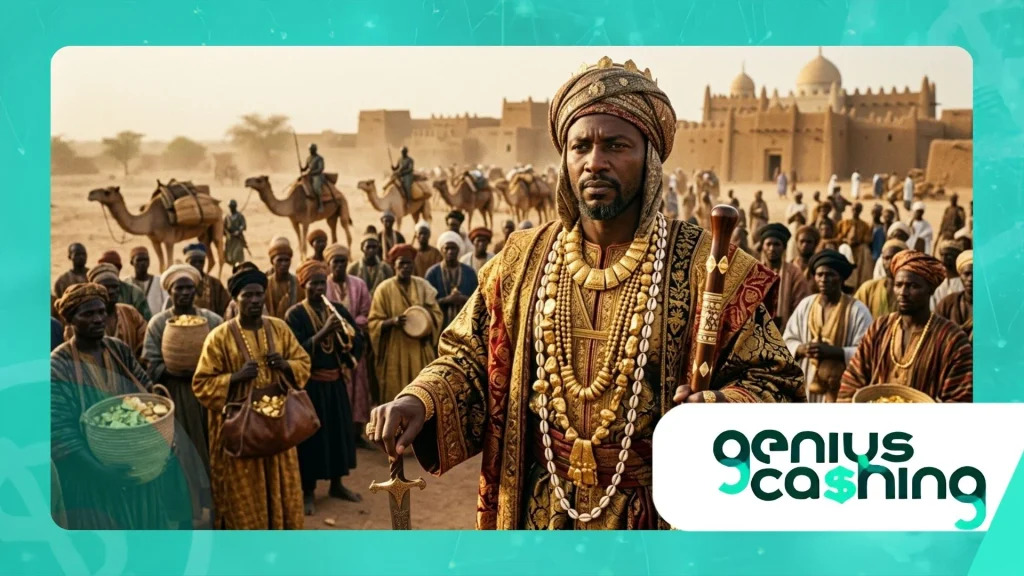
How Did Mansa Musa Accumulate His Incalculable Fortune?
Mansa Musa ascended the throne of the Mali Empire in 1312 during a golden age of trans-Saharan trade routes.
Anúncios
His territorial conquest expanded Mali across 2,000 miles, encompassing modern-day Senegal, Gambia, Guinea, Niger, Nigeria, Chad, and Mauritania.
By capturing key strategic nodes along trade corridors, he instituted strict taxation protocols on every ounce of gold and salt crossing his borders.
His dominion held complete monopoly power over three massive gold fields: Bambuk, Bouré, and Galam.
According to economic historian Rudolph Ware, Musa’s absolute control over production meant his reserves were practically unlimited for the era.
A Ruler Whose Wealth Could Rival Modern Economies understood that controlling both the production source and the logistics network guaranteed complete market dominance.
Why Is Mansa Musa Considered the Richest Person in History?
Determining precise monetary figures for medieval rulers presents significant accounting challenges, yet economic historians place Mansa Musa’s net worth at an estimated $400 billion in adjusted terms.
Some scholars argue that calculating his wealth is impossible because absolute monarchs owned state assets directly without distinguishing personal accounts.
His empire’s gold production sustained the currency systems of the entire Mediterranean world and Islamic Middle East.
When comparing his wealth to contemporary figures, his capital reserves exceeded the combined GDPs of several modern G7 nations during their early development.
His economic footprint dwarfed European kingdoms of the 14th century, which were plagued by civil conflicts, agrarian failures, and devastating plagues.
The sheer scale of his gold reserves made Mali the undisputed economic epicenter of the Old World.
++ Curiosities About Billionaires Who Refused Luxury Lifestyles
What Role Did Gold and Salt Trade Play in the Empire’s Boom?
Gold provided international trade power, but salt functioned as the essential domestic currency across West Africa.
In sub-Saharan regions, salt was prized equally to precious metals due to its necessity for food preservation and human survival.
Mansa Musa taxed the north-south trade routes heavily, collecting tribute in gold from the south and salt from the north.
This dual-commodity control produced an economic engine of unmatched efficiency and stability. Trade caravans comprising thousands of camels regularly crossed the Sahara under royal protection to exchange goods safely.
This secure commercial framework attracted merchants from Cairo, Baghdad, and Venice, solidifying Timbuktu and Gao as wealthy trade hubs.
How Did Mansa Musa’s Pilgrimage Impact Mediterranean Economies?
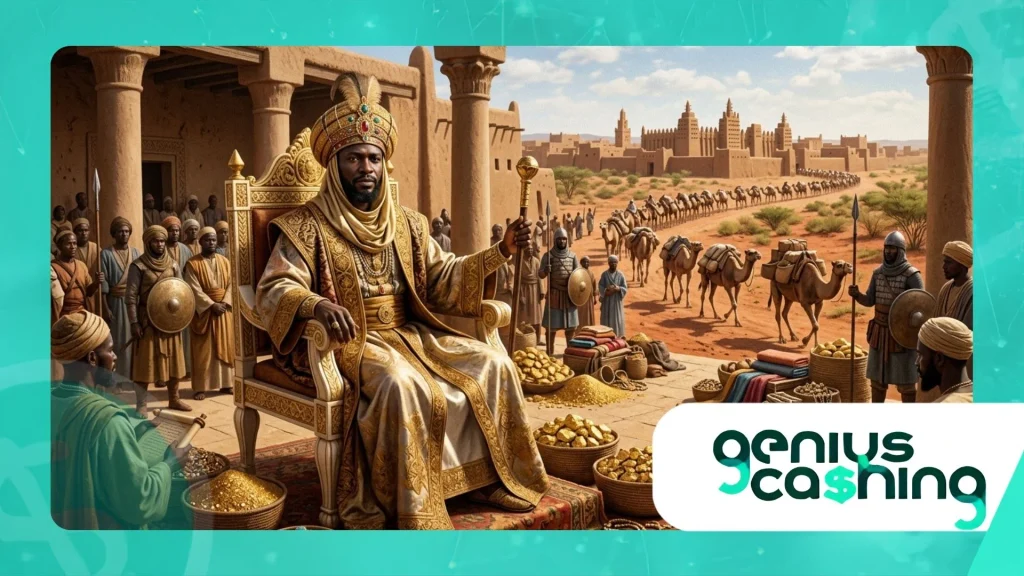
What Happened During the Infamous 1324 Journey to Mecca?
In 1324, Mansa Musa embarked on his legendary 4,000-mile Hajj to Mecca, presenting his empire’s immense affluence to the broader world.
His caravan included 60,000 men, including 12,000 royal servants who each carried four pounds of pure gold bars. Eighty camels carried between 50 and 300 pounds of gold dust each, which was distributed freely to citizens along the path.
This majestic procession captivated every city it traversed, especially Cairo, Medina, and Mecca.
Another instance featuring a Ruler Whose Wealth Could Rival Modern Economies altering international trade dynamics occurred when his massive spending spree introduced vast quantities of gold into foreign markets.
His generosity transformed his pilgrimage into an unprecedented show of global economic influence.
Also read: The Most Expensive Business Handshake Ever Recorded
How Did the Mali Empire Cause a Decade of Regional Inflation?
The sudden influx of hundreds of kilograms of gold into Cairo’s economy severely devalued the local currency.
Supply flooded the market instantly, driving down the purchasing power of gold bullion across Egypt, Syria, and the Arabian Peninsula.
Prices for basic consumer goods, textiles, and foodstuffs skyrocketed as merchants adjusted to the sudden liquidity boost.
Historical records by Arab historian Ibn Khaldun confirm that Cairo’s financial markets required over twelve years to fully stabilize from the economic shock.
To rectify the currency crisis on his return trip, Musa borrowed back large quantities of gold from Cairo money lenders at high interest rates.
This single-handed manipulation of foreign money markets remains a unique historical event caused by an individual.
Read more: How a Parking Lot Became a Billion-Dollar Investment
What Historical Accounts Document This Unprecedented Financial Event?
Famous Moroccan explorer Ibn Battuta visited the Mali Empire decades later and documented its exceptional administrative security and prosperous commercial infrastructure.
Syrian scholar Al-Umari recorded accounts from Cairo citizens who met the emperor, describing Musa’s immense generosity and polite demeanor toward local officials.
These independent contemporary accounts confirm that the reports of his vast fortune were accurate rather than myth.
These historical chroniclers noted that Mali enjoyed an enviable judicial system where theft was virtually nonexistent, ensuring safe international commerce.
The empire’s reputation reached European cartographers, leading to his prominent inclusion in the famous 1375 Catalan Atlas.
Depicted holding a massive gold orb atop a golden throne, Musa became the universal symbol of West African wealth.
What Is the Lasting Economic and Cultural Legacy of Mali?
How Did Mansa Musa Transform Timbuktu Into a Global Hub?
Upon returning from his pilgrimage, Mansa Musa reinvested his vast fortune into urban development, civic architecture, and public scholarship.
He commissioned Andalusian architect Abu Es Haq es-Saheli to construct the world-famous Djinguereber Mosque and a grand royal palace in Timbuktu.
Using innovative earth-brick construction techniques, these architectural masterpieces transformed the desert settlement into a permanent urban metropolis.
Timbuktu swiftly became an international destination for scholars, jurists, mathematicians, and astronomers from across Africa and the Middle East.
The University of Sankore was expanded, eventually housing over 250,000 academic manuscripts across various scientific disciplines.
Musa realized that sustainable long-term legacy required converting finite mineral wealth into enduring intellectual capital.
How Does Medieval Imperial Wealth Compare to Modern Sovereign Funds?
Analyzing ancient wealth through modern economic concepts reveals strong similarities to contemporary sovereign wealth funds managed by resource-rich nations.
Mali managed state revenues by balancing gold reserves, investing in trade infrastructure, and subsidizing international diplomatic relations.
A Ruler Whose Wealth Could Rival Modern Economies demonstrated how monopolistic control over vital global commodities yields unparalleled geopolitical leverage.
| Economic Metrics & Indicators | Mansa Musa’s Mali Empire (c. 1324) | Contemporary Tech Giants / Modern Wealth |
| Primary Wealth Source | Gold Extraction & Trans-Saharan Salt Monopoly | Technology, Intellectual Property & Data |
| Estimated Peak Valuation | ~$400 Billion (Adjusted Real Assets) | $200B – $250B (Net Worth of Top Individuals) |
| Market Control Share | >50% of Old World Circulating Gold Supply | 15% – 35% Market Share in Core Tech Sectors |
| Geopolitical Financial Impact | Single-handedly caused 12-year regional inflation | Market capitalization rivaling mid-tier nation GDPs |
| Capital Investment Focus | Universities, Mosques, Trade Logistics & Civics | Research & Development, Acquisitions & Cloud Infrastructure |
Why Did the Mali Empire Eventually Decline Financially?
Following the death of Mansa Musa in 1337, his successors struggled to maintain central political authority across such a vast territory.
Internal dynastic disputes over succession weakened imperial control over peripheral provinces, allowing vassal states like Songhai to assert independence.
Strategic trade routes gradually shifted outward, diminishing the central government’s tax collections from trans-Saharan caravans.
Additionally, European exploration in the late 15th century established direct maritime trade routes along the West African coast.
This shift bypassed the traditional inland trans-Saharan trade corridors, draining Timbuktu of its historic commercial advantage.
Without efficient centralized management, the empire’s unmatched wealth slowly dissipated into competing regional powers.
What Lessons Can Modern Markets Learn From Historic Fortunes?
The historical trajectory of 14th-century West Africa offers insightful lessons regarding commodity dependence, monetary policy, and infrastructure investment.
Mansa Musa proved that holding raw physical wealth is insufficient without establishing permanent academic and municipal infrastructure.
His story highlights how rapid liquidity expansion can inadvertently destabilize foreign trade partners if financial distribution is uncalibrated.
Furthermore, his administrative policies illustrate the importance of legal security in fostering regional business confidence and attracting foreign investment.
By establishing safe passage for international caravans, Mali created a resilient trading zone that prospered for generations.
Studying a Ruler Whose Wealth Could Rival Modern Economies provides valuable perspectives on national wealth management, sovereign liquidity, and long-term capital strategy.
Have you ever visited historic trade hubs or studied medieval economics? Share your thoughts and perspective in the comments section below!
Frequently Asked Questions
How much would Mansa Musa’s wealth be worth today?
Historians estimate his net worth at roughly $400 billion in adjusted terms, though many experts argue his wealth was essentially priceless due to his absolute ownership of half the world’s gold supply.
Where did Mansa Musa get most of his gold?
His gold originated primarily from three rich gold fields within his imperial borders: Bambuk, Bouré, and Galam, which supplied the Mediterranean and Middle Eastern markets.
How did Mansa Musa affect Egypt’s economy during his Hajj?
He gave away and spent so much gold in Cairo that he flooded the local market, devaluing gold and causing severe price inflation that took over twelve years to normalize.
Is there any remaining architecture built by Mansa Musa?
Yes, the famous Djinguereber Mosque in Timbuktu, designed by architect Abu Es Haq es-Saheli under Musa’s direct patronage, still stands and remains active today.
Why did the Mali Empire lose its economic dominance?
Internal succession struggles, loss of control over key trade routes, and the shift toward Atlantic maritime trade reduced the central government’s revenue and weakened imperial control.
