
The Coffeehouse That Helped Shape the Modern Insurance Industry
Anúncios
The coffeehouse that helped shape the modern insurance industry transformed global commerce by turning a simple London gathering place into the world’s premier risk marketplace.
In the late seventeenth century, Edward Lloyd opened a modest establishment on Tower Street that quickly became the central hub for maritime updates, ship captains, and merchant underwriters.
Today, that legacy lives on in Lloyd’s of London, which continues to write primary policies and underwrite complex global risks.
Understanding this historic evolution shows how modern policy structures, risk pooling, and underwriting criteria developed into the commercial protection frameworks businesses rely on today.
Core Highlights
- Historical Origins: How Edward Lloyd’s 1688 establishment laid the foundation for institutional marine underwriting.
- Mechanism of Risk Pooling: The transition from casual merchant handshakes to structured syndicate underwriting.
- Modern Market Practices: How 17th-century ocean bills of lading mirror today’s digital risk management strategies.
- Comparative Industry Data: Key metrics tracing the evolution from historic coffeehouse agreements to contemporary insurance markets.
- Strategic Risk Analysis: Practical insights for businesses evaluating complex commercial risk coverage today.
Why Did a 17th-Century Coffeehouse Become the Hub of Global Risk Transfer?

How Did Edward Lloyd Create the World’s First Commercial Information Network?
Edward Lloyd opened his coffeehouse around 1688 on Tower Street in London, catering specifically to ship captains, merchants, and vessel owners.
Anúncios
He realized early on that reliable information was more valuable than the beverages he served to his clientele.
To keep his patrons informed, Lloyd published news sheets containing shipping arrivals, port conditions, and atmospheric observations recorded along trade routes.
Merchants gathered at these wooden tables precisely because accurate intelligence allowed them to calculate maritime danger with unprecedented clarity.
By aggregating reliable shipping data under one roof, Lloyd laid the structural groundwork for systemic marine underwriting.
The coffeehouse environment fostered an informal yet disciplined exchange of capital among wealthy patrons willing to back dangerous voyages.
Investors prospective for profit would review a vessel’s manifest, evaluate the master’s reputation, and write their names beneath the risk amount they agreed to cover.
This practice birthed the term “underwriter,” defining a financial discipline that still dictates policy creation today.
The informal clearinghouse transformed maritime trade from a high-stakes gamble into a calculated commercial venture. As a result, shipowners gained the financial security required to explore new trade routes across global oceans.
++Bundled Insurance for Small Business: Worth It or Overhyped?
Why Was Shipping News the Essential Currency of Early Insurance Markets?
In an era before telegraphs or digital communications, maritime trade suffered from severe information asymmetry that paralyzed international investments.
Lloyd solved this operational bottleneck by employing runners to gather intelligence directly from customs houses and arriving vessels.
His dedicated bulletin, later formalized as Lloyd’s List, provided standardized data that allowed underwriters to assess loss probabilities accurately.
This real-time intelligence network turned speculative maritime bets into measurable financial risks backed by contract terms.
Consequently, transparent data collection became the mandatory foundation for all commercial underwriting endeavors.
Without reliable shipping news, early capital syndicates could not price marine policies accurately or guard against fraudulent claims.
Lloyd’s systematic aggregation of maritime intelligence established the fundamental principle of uberrimae fidei, or utmost good faith, between insured parties and insurers.
Underwriters relied entirely on truthful disclosures regarding cargo weight, hull integrity, and intended navigation routes.
Today, modern marine insurers still utilize these exact principles when evaluating complex commercial property risks and supply chain disruptions.
The primitive shipping bulletin directly evolved into the sophisticated risk matrices used across the global financial sector.
How Did Coffeehouse Underwriting Evolve Into Modern Commercial Insurance Systems?
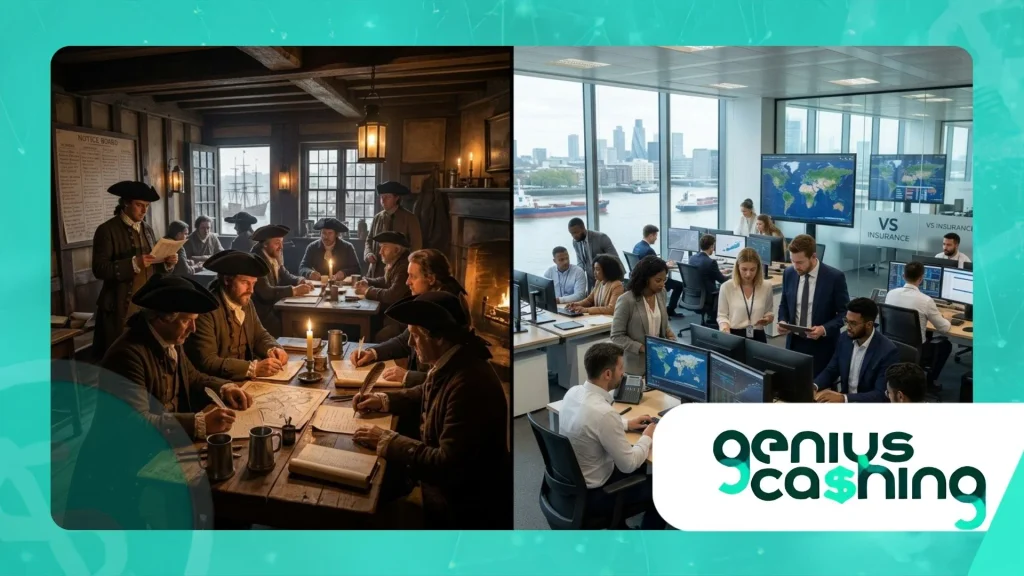
How Did Casual Table Agreements Become Formal Syndicate Contracts?
The informal gatherings at Lloyd’s coffeehouse gradually required formal governance as maritime trade expanded rapidly across the globe.
By 1774, the underwriters relocated to the Royal Exchange and established a dedicated society governed by an elected committee.
This administrative shift replaced verbal handshakes with standardized policy documents, establishing clear legal definitions for partial losses and total hull sinkings.
The formalization of syndicate capital allowed individual investors to share massive commercial exposures without facing single-handed bankruptcy.
This organizational structure formed the bedrock of modern subscription insurance policies used for massive commercial assets.
Modern risk transfer relies heavily on the syndicate model pioneered during those early decades at the Royal Exchange. Instead of a single insurer bearing the entire weight of a commercial asset, multiple capital providers share portions of the coverage.
This collaborative approach allows the industry to cover extraordinary liabilities, ranging from commercial satellite launches to complex cyber-breach protections.
The historical transition from casual table agreements to regulated financial syndicates demonstrates how the coffeehouse that helped shape the modern insurance industry built our resilient global economy.
Today’s commercial policyholders directly benefit from this historical risk-sharing model.
Also read: Do You Really Need Insurance as a Solopreneur? A Risk-Based Breakdown
Why Do Ancient Marine Principles Still Dictate Contemporary Policy Terms?
Ancient marine insurance covenants introduced foundational legal concepts that remain vital within modern policy contracts.
For example, the principle of general average requires all cargo owners to proportionally compensate any merchant whose goods were sacrificed to save the vessel.
Early underwriters recognized that collective safety required shared financial responsibility during sudden catastrophic events at sea.
Modern property policies preserve this logic through deductible structures, co-insurance clauses, and shared risk retention protocols.
The fundamental mandate to balance individual exposure with collective capital pools has remained unchanged for centuries.
Furthermore, early underwriters realized that physical inspections and vessel classifications were mandatory to prevent adverse selection.
This necessity birthed classification societies that systematically rated hull construction, maintenance quality, and sailing gear.
Today, commercial property insurers apply these identical evaluation techniques when inspecting building fire suppression systems, structural integrity, and cybersecurity protocols.
Risk assessment remains an ongoing investigation into physical operational safety rather than a passive financial transaction. Ancient maritime mandates continue to protect commercial operations across every major global sector.
What Can Modern Businesses Learn From Historical Insurance Frameworks?
How Does Historical Risk Diversification Protect Today’s Global Supply Chains?
Early maritime underwriters never allocated their entire financial capital to a single merchant vessel sailing into treacherous waters.
Instead, they distributed their capital across dozens of distinct merchant voyages traveling across different trade corridors.
This tactical diversification protected syndicates from catastrophic collapse whenever severe storms or privateer attacks wiped out specific trade fleets.
Modern enterprise risk management relies on this identical diversification logic to insulate balance sheets from sudden disruptions. Businesses must diversify their operational exposures across multiple geographic markets and risk-transfer instruments.
Contemporary global supply chains face volatile disruptions ranging from regional geopolitical conflicts to sudden climate events.
Companies that analyze their operational dependencies through historical risk-pooling principles build far more resilient business models.
By utilizing captive insurance entities, parametric coverage, and layered commercial policies, modern firms protect their liquidity against uninsurable losses.
The strategic lessons forged in 17th-century London offer clear guidance for navigating unpredictable global markets. Diversification remains the ultimate defensive strategy against sudden operational catastrophes.
Read more: Insuring Intangibles: How to Protect Your Brand Legally
Why Is Transparency the Primary Pillar of Modern Underwriting Relationships?
The early success of coffeehouse underwriting depended entirely upon total transparency between ship captains and prospective capital providers.
If a captain concealed structural hull defects or altered sailing routes without notice, the underwriting agreement was rendered null and void.
Modern commercial insurance markets maintain this exact standard through rigorous underwriting audits and mandatory disclosure rules.
Organizations that proactively disclose operational metrics, safety records, and risk mitigation protocols secure significantly better coverage terms. Transparency directly lowers capital costs for commercial policyholders operating in complex risk environments.
In an era of rising commercial premiums, maintaining an open dialogue with underwriting syndicates is critical. Businesses that implement robust risk management frameworks present a far lower loss frequency to commercial insurers.
According to industry statistics from Swiss Re, global insured losses from natural catastrophes reached $108 billion in 2023, underscoring the vital need for clear risk modeling and mitigation.
Companies using data analytics to demonstrate risk controls achieve superior pricing during annual policy renewals. Open communication remains the single most effective tool for managing institutional risk transfer costs.
Historical vs. Modern Insurance Market Architecture
The structural evolution of risk transfer demonstrates how basic merchant agreements transformed into today’s sophisticated global capital markets. The table below outlines the core differences between early coffeehouse operations and contemporary insurance practices.
| Architectural Dimension | 17th-Century Coffeehouse Market | Modern Commercial Insurance Market |
| Primary Trading Venue | Tower Street Coffeehouse, London | Global Digital Exchanges & Lloyd’s Building |
| Information Gathering | Hand-written logs and marine bulletin sheets | Real-time telemetry, IoT sensors & AI analytics |
| Capital Allocation | Individual wealthy merchant underwriters | Institutional syndicates, reinsurers & CAT bonds |
| Risk Assessment Method | Captain reputational history & visual hull inspection | Algorithmic predictive modeling & actuarial tables |
| Legal Framework | Informal merchant customs & early maritime law | Standardized international policy codes & statutes |
Resilient Capital: The Enduring Legacy of Marine Underwriting
The journey from a modest London tavern to a global financial industry proves that risk management is essential for economic growth.
Without early maritime underwriters willing to absorb voyage risks, international trade would have stalled under the weight of financial uncertainty.
The innovative spirit that flourished in Tower Street established the capital frameworks that fuel modern global commerce today.
As businesses navigate emerging threats like climate volatility and digital disruption, the coffeehouse that helped shape the modern insurance industry remains a timeless model of operational adaptation.
Navigating contemporary corporate insurance requirements demands a comprehensive understanding of risk pooling, contract structures, and proactive exposure management.
Organizations must view their insurance portfolios not as passive overhead, but as strategic instruments that protect future growth.
By partnering with experienced brokers and maintaining transparent risk profiles, enterprises safeguard their capital against unexpected operational shocks.
Strategic risk transfer remains the most reliable foundation for long-term commercial innovation. Share your perspective on how historical insurance practices influence your corporate risk management strategy today.
Frequently Asked Questions
What role did Edward Lloyd play in creating modern commercial insurance?
Edward Lloyd did not personally underwrite policies, but he created the essential information infrastructure that made marine underwriting possible.
By collecting accurate shipping intelligence and providing a dedicated gathering venue, he enabled merchants to evaluate and price risk accurately.
How did the term “underwriter” originate in early London coffeehouses?
The term originated when individual investors wrote their names and financial commitments underneath the description of a risk on a paper document.
By signing beneath the text, they legally agreed to absorb a specific portion of the financial loss if the ship sank.
Why was maritime shipping the first industry to use organized insurance?
Maritime commerce involved massive capital expenditures and extreme operational risks that single shipowners could rarely afford to lose.
Insurance created a financial safety net, allowing merchants to trade across oceans without risking immediate bankruptcy from a single shipwreck.
How does the historical syndicate model operate in today’s financial markets?
Modern syndicates operate by combining capital from multiple financial backers to underwrite large, complex corporate risks.
This subscription approach ensures that no single company bears total financial liability for catastrophic property, liability, or aerospace losses.
What is the main principle inherited from early coffeehouse underwriting?
The primary principle inherited from early coffeehouse underwriting is uberrimae fidei, or utmost good faith.
This foundational rule mandates that both the insured party and the underwriter disclose all relevant material facts honestly before a contract becomes legally binding.
