
How Al Capone’s Financial Crimes Changed U.S. Tax Law

Anúncios
Al Capone’s Financial Crimes Changed the very fabric of American fiscal policy, proving that the pen and the ledger can be mightier than the machine gun.
In the heart of the 1920s, the “Public Enemy Number One” seemed untouchable by standard criminal laws, forcing a radical shift in federal strategy.
Justice officials realized that while blood leaves stains, money leaves a trail, leading to the birth of modern forensic accounting as a primary weapon.
Today, in 2026, we still see the echoes of these tax strategies in how the IRS pursues high-level white-collar criminals across the globe.
Historical Evolution of Tax Enforcement
- The Untouchable Era: Why traditional police work failed to stop the Chicago Outfit’s reign of terror.
- The Supreme Court Pivot: The landmark 1927 Sullivan ruling that declared illegal income taxable.
- Forensic Accounting Birth: How Frank J. Wilson used receipts and net-worth analysis to build an airtight case.
- Permanent Legacy: The lasting impact on the Internal Revenue Code and federal prosecution methods.
What is the legacy of Al Capone’s tax evasion and why does it matter?
The way Al Capone’s Financial Crimes Changed American law is rooted in the realization that organized crime thrives on invisible, untaxed wealth.
Anúncios
Federal agents initially struggled because witnesses were too terrified to testify about murders, but numbers on a page could not be intimidated.
The prosecution focused on a simple paradox: if a man lives like a millionaire without a job, he must be hiding taxable income.
This approach transformed the Internal Revenue Service (IRS) from a simple collection agency into a powerful investigative branch of the American government.
Why did the 1927 Supreme Court ruling change everything?
The case of United States v. Sullivan established that criminals must report income from illegal activities, essentially forcing them to confess or lie.
If they reported the money, they admitted to crimes; if they didn’t, they committed tax evasion, creating a perfect legal trap for mobsters.
++ The Curious Case of Countries That Printed $0 Bills
How did the Treasury Department win the war?
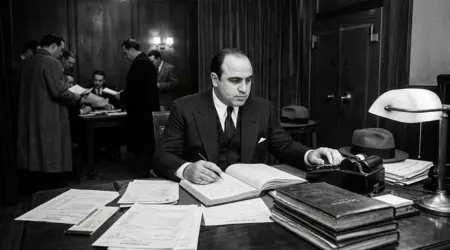
Special Agent Frank Wilson spent years meticulously reviewing over two million documents to find a single ledger linking Capone to gambling profits.
This dogged persistence showed that financial transparency is the ultimate Achilles’ heel for even the most sophisticated and violent criminal organizations.
How does the IRS use these ancient methods in 2026?
Modern tax authorities still rely on the “net worth method” developed during the Capone investigation to track down digital currency evaders today.
As Al Capone’s Financial Crimes Changed the legal landscape, it paved the way for the Racketeer Influenced and Corrupt Organizations (RICO) Act.
In our current era of 2026, AI-driven forensic tools scan blockchain ledgers with the same tenacity Wilson applied to dusty paper books a century ago.
The principle remains identical: if your lifestyle exceeds your reported earnings, the burden of proof falls on the taxpayer to explain the gap.
Also read: When a Bank Robbery Led to the Invention of Bulletproof Finance
What is the role of forensic accounting today?
Financial investigators now use predictive algorithms to spot anomalies in global transactions, catching tax havens that were previously invisible to the naked eye.
These specialists combine the grit of a detective with the precision of a mathematician to dismantle cartels through their bank accounts.
Read more: The Real Cost of a Medieval Knight — In Today’s Dollars
Can criminals hide in digital currencies?
While crypto offers some anonymity, the “Capone strategy” focuses on the point where digital wealth is converted into physical luxury goods and assets.
Buying a mansion with “anonymous” coins triggers the same red flags that Capone’s silk suits and armored Cadillacs did during the Prohibition era.
Why are financial crimes more dangerous than physical violence for the Mob?
History demonstrates that Al Capone’s Financial Crimes Changed the power dynamic because seizing money is more effective than making arrests.
A mob boss can be replaced from a prison cell, but a seized treasury leaves an organization incapable of paying its soldiers or bribes.
Think of an organized crime syndicate as a massive engine; without the fuel of untaxed cash, the entire machine grinds to a sudden halt.
By attacking the pocketbook, the government essentially suffocates the criminal enterprise, making it impossible for the structure to survive or rebuild itself.
Comparison: Criminal Tactics vs. Federal Response (1931)
| Capone’s Tactic | Federal Counter-Action | Legal Result |
| Murder/Intimidation | Forensic Accounting | Witness safety became less critical |
| Cash-Only Operations | Net Worth Analysis | Unexplained wealth became evidence |
| Bribing Local Police | Federal IRS Agents | Jurisdiction moved to federal level |
| Hidden Ownership | Expenditure Tracking | 11-year prison sentence in 1931 |
What was the final blow to the Chicago Outfit?
Capone was eventually sentenced to 11 years in prison, not for the St. Valentine’s Day Massacre, but for failing to file returns.
The IRS estimated he owed over $215,000 in back taxes, a staggering sum in 1931 that effectively bankrupted his personal influence and power.
How did this change public perception?
The public learned that the “Great Al Capone” was not defeated by a heroic shootout, but by a group of quiet men with green eyeshades.
This shifted the narrative of the gangster from a romanticized outlaw to a common tax cheat, stripping away much of the mob’s charisma.
How did Al Capone’s downfall influence modern RICO laws?
The realization that Al Capone’s Financial Crimes Changed the world led directly to more aggressive laws designed to prosecute the entire criminal hierarchy.
RICO laws allow the government to charge leaders for the crimes of their subordinates, provided there is a clear financial or organizational link.
If Capone were active in 2026, he would face immediate asset forfeiture and global sanctions before he even stepped foot into a courtroom.
We now view the “organization” itself as the criminal entity, an evolution that started when the IRS first looked at a mobster’s ledger.
Why is the burden of proof different in tax cases?
In tax court, the government only needs to show a discrepancy between reality and reporting, which is often easier than proving a specific murder.
This “civil-to-criminal” pipeline remains one of the most feared tools in the Department of Justice’s arsenal for high-profile investigations and trials.
What is the analogical impact of the “Capone Trap”?
Using tax law to catch a murderer is like using a fishing net to catch a shark; the method might seem delicate, but the result is inescapable.
The net doesn’t care how sharp the shark’s teeth are; it only cares about the physical reality of the shark’s presence within its woven borders.
Have you ever wondered if the modern hackers and crypto-scammers of 2026 feel the same shadow of the IRS that Capone once did?
The Enduring Power of the Ledge
The story of how Al Capone’s Financial Crimes Changed history serves as a permanent reminder that no criminal is truly above the law’s reach.
By shifting the focus from the act of the crime to the profit of the crime, the U.S. government created a sustainable model for justice.
Capone’s ultimate defeat in 1931 established the precedent that the tax collector is the most formidable adversary for any illicit and profitable enterprise.
As we navigate the complexities of 2026’s global economy, the lessons of the “Untouchables” and their accountants remain as relevant as they ever were.
Financial integrity is the foundation of a stable society, and those who try to bypass it eventually find themselves trapped by their own greed.
Do you think modern digital wealth makes it easier or harder to repeat Capone’s mistakes? Share your experience in the comments below!
Frequently Asked Questions
Did Al Capone ever go back to crime after prison?
No, his health declined significantly due to neurosyphilis while at Alcatraz, and he lived a quiet, secluded life in Florida until his death.
How much would Al Capone owe in taxes today?
Adjusted for 2026 inflation, his unpaid taxes and penalties would likely exceed several million dollars, not including the massive interest accrued over a century.
Is it true he was caught because of a single ledger?
Yes, a ledger found during a raid on a gambling den contained the names of his associates and specific profit splits, which was the “smoking gun.”
Why didn’t they just charge him with murder?
Witnesses were consistently murdered or intimidated into silence, making it impossible for the state to build a reliable case for violent crimes in open court.
