
The history of central banks and their role in modern economies
Anúncios
Central banks are authorities responsible for shaping a country’s monetary policy and maintaining financial stability. These institutions utilize various tools, such as interest rate adjustments and credit regulations, to influence the money supply and achieve their primary objectives: price stability, economic stability, and financial stability.
The origins of central banking can be traced back to the 17th century, with the establishment of the Swedish Riksbank in 1668 as the world’s first central bank.
This joint-stock bank was initially tasked with lending government funds and acting as a commercial clearinghouse. In 1694, the Bank of England was founded, primarily to assist the government in managing its debt. Later in 1800, the Banque de France was established by Napoleon to stabilize the French currency and support the government’s financial needs following the hyperinflation of the French Revolution.
The 20th century saw the creation of the Federal Reserve System in the United States, which aimed to unify various currency instruments and provide financial stability, particularly in response to the banking crises and economic turmoil of the early 1900s. Over time, central banks have evolved their roles, shifting from a primary focus on maintaining the convertibility of their notes to the gold standard to a greater emphasis on domestic economic stability, employment, and price-level management.
Origins and Early Development of Banking Systems
The foundations of modern banking can be traced back to the 17th century, a period marked by the establishment of some of the earliest central banks.
Anúncios
The Swedish Riksbank, founded in 1668, is widely regarded as the first central bank, chartered to lend government funds and serve as a clearing house for commerce. Soon after, the Bank of England, established in 1694, became the most renowned central bank of its era.
These early central banks played a crucial role in the economic development of their respective nations. They issued private banknotes that served as currency and often held monopolies over note issuance. By facilitating transactions between banks and providing essential banking services, these institutions became repositories for most banks due to their large reserves and extensive networks.
The evolution of the banking system continued to shape economic growth and stability in the centuries that followed. The First Bank of the United States, chartered in 1791 and operating until 1811, was an early example of a central banking institution in the United States.
Its establishment and subsequent closure highlighted the ongoing debate around the role of central banking in the country’s economic development.
As the United States transitioned through different eras, such as the Free Banking Era from 1836 to 1865 and the National Banking System during the Civil War, the banking landscape continued to evolve, reflecting the country’s changing needs and the ongoing discussion around the proper role of financial institutions in the economy.
The Panic of 1907 and the subsequent call for a more stable central banking system ultimately led to the establishment of the Federal Reserve in 1913. This decentralized central bank was designed to manage monetary policy, regulate banks, maintain financial stability, and provide banking services to the government and financial institutions, marking a significant milestone in the history of central banking in the United States.
“The origins of central banking can be traced to the 17th century, with the establishment of institutions like the Swedish Riksbank and the Bank of England, which played a crucial role in shaping the economic development of their respective nations.”
The Birth of American Banking: Continental Currency Era
The American Revolution was a pivotal moment in the history of American banking. As the Continental Congress sought to finance the war, they turned to printing their own paper currency, known as “continentals.” These notes were intended to be redeemable on demand in specie (gold or silver coin), but as the war progressed, the government continued to print more currency, leading to rampant inflation.
After the Revolutionary War, the new nation faced substantial debt and lacked a common currency, with many states printing their own money.
These financial problems were among the chief concerns of the nation’s founders around the time the Constitution was written. Alexander Hamilton, the first U.S. Secretary of the Treasury, proposed having the federal government take over the states’ war debts to address these issues and establish federal power.
The Continental Congress’ decision to print paper money had far-reaching consequences. By 1780, the Continental Currency notes had been devalued to one-fortieth of their original face values, leading to a loss of public confidence in the new nation’s currency.
| Year | Event | Impact |
|---|---|---|
| 1775 | The Continental Congress introduced the first American national paper money to meet military expenditures. | This helped finance the American Revolution, but also led to inflation as the war progressed. |
| 1792 | The U.S. established the dollar as its principal unit of currency, becoming the first country in the world to adopt the decimal system for currency. | This standardized the currency and helped establish the nation’s financial system. |
| 1863 | The National Banking Act permitted sound private banks to issue their own notes under a unified national currency system. | This helped create a more stable and unified currency, reducing the issues caused by state-issued currencies. |
The birth of American banking during the Continental Currency era laid the foundation for the nation’s financial system, though it also highlighted the challenges of establishing a cohesive and stable currency. The lessons learned during this period would shape the development of banking and currency in the United States for years to come.
The First Bank of the United States (1791-1811)
The First Bank of the United States was a pivotal institution in the early days of American banking. Established in 1791 under the leadership of Alexander Hamilton, then Treasury Secretary, the bank was modeled after the Bank of England and played a crucial role in establishing financial stability in the young nation.
The bank was granted a 20-year charter and started operations in December 1791 with a capitalization of $10 million, of which $2 million was owned by the federal government and the remaining $8 million by private investors. The initial public offering (IPO) of shares was the largest in the country at the time, attracting foreign investors, despite their lack of voting rights.
The First Bank of the United States had a significant influence over the country’s finances due to its size and role as the federal government’s fiscal agent. It collected tax revenues, secured government funds, made loans to the government, and managed U.S. Treasury interest payments to European investors in government securities.
The bank’s notes also influenced the national money supply, and it could adjust interest rates by managing lending policies and fund flows, impacting the broader economy.
The bank’s branch system facilitated tax revenue collection, financing international trade, and supported the westward expansion of the United States. It held substantial gold reserves, providing a relatively stable national currency to the country and was the largest financial institution holding federal government deposits.
However, the bank’s charter was not renewed when it expired in 1811, marked by debates in Congress and opposition from state banks and political parties who argued it was unconstitutional. The Second Bank of the United States was later established in 1816, five years after the First Bank’s closure.
| Key Facts about the First Bank of the United States | Details |
|---|---|
| Established | 1791 |
| Charter Duration | 20 years |
| Capitalization | $10 million ($2 million owned by federal government, $8 million by private investors) |
| Largest IPO at the Time | Yes |
| Fiscal Agent for Federal Government | Yes |
| Influenced National Currency and Money Supply | Yes |
| Held Significant Gold Reserves | Yes |
| Charter Renewal | Not renewed in 1811 |
The architectural features of the First Bank building, including a marble keystone with the head of Mercury, a carved panel depicting a baby representing America, and a display of an eagle on the pediment symbolizing America’s power and promise, serve as a lasting testament to the significance of this institution in the early days of the United States.
“The First Bank of the United States was a pivotal institution in the early days of American banking, playing a crucial role in establishing financial stability in the young nation.”
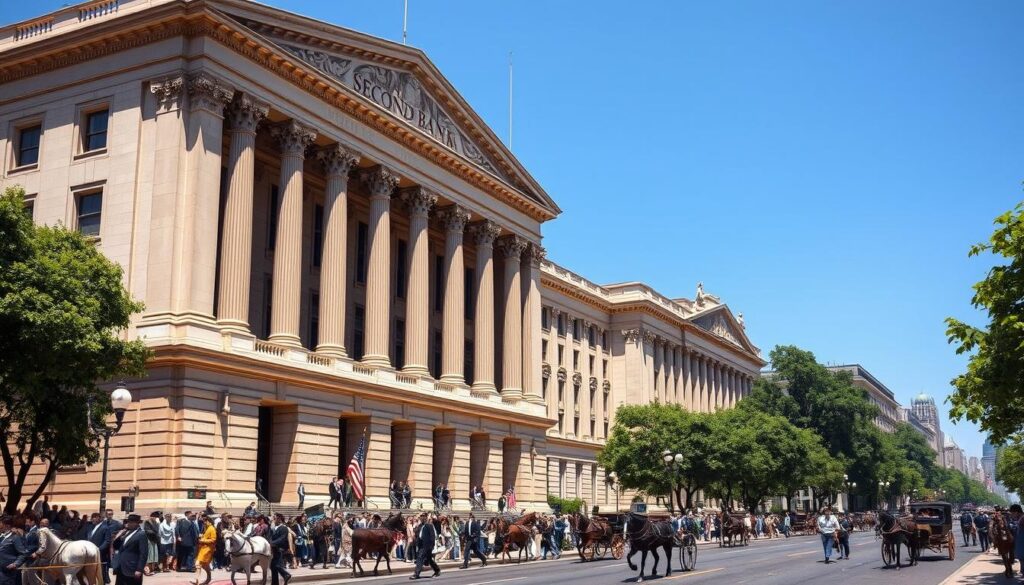
The Second Bank and Its Challenges (1816-1836)
In the aftermath of the War of 1812, the United States sought to establish a stable financial system. The Second Bank of the United States was chartered in 1816 with a capital of $35 million, significantly higher than the $10 million underwriting of the First Bank. The new bank had a total of twenty-five branches, a considerable increase compared to the eight branches of its predecessor.
Initially, the Second Bank faced poor management, but it was saved from collapse in 1819 by Langdon Cheves. The bank’s leadership then passed to Nicholas Biddle in 1822, who guided the institution through a period of effective operations until 1836.
However, the Second Bank’s role was not without controversy. President Andrew Jackson, known for his opposition to banks, refused to renew the bank’s charter in 1832, effectively crippling the institution until its federal charter expired in 1836. This conflict, known as the Bank War, was a significant episode in the history of bank regulation and uniform currency in the United States.
“The bank, Mr. Van Buren, is trying to kill me, but I will kill it.”
– President Andrew Jackson, on his opposition to the Second Bank of the United States
The Second Bank’s demise marked the end of a centralized banking system in the United States until the establishment of the Federal Reserve in 1913. This period, known as the Free Banking Era, saw the proliferation of state-chartered banks and the continued lack of a uniform currency.
The History of Central Banks Through the Free Banking Era
The period from 1837 to the Civil War, known as the Free Banking Era, witnessed a significant transformation in the American banking landscape.
During this time, states began passing “free bank laws” that allowed banks to operate under less stringent charters. Under these laws, banks were required to deposit government bonds with state auditors as collateral for the issued notes, which they were then obligated to redeem on demand in specie (gold or silver coin).
This led to the proliferation of hundreds of new state-chartered banks across the country. The free bank notes they issued, however, often circulated at varying discounts, depending on the perceived financial stability of the issuing institution. In this chaotic environment, the Suffolk Bank in New England took on some central bank-like roles, such as clearing payments between banks and disciplining those that failed to maintain sound financial practices.
The Free Banking Era also saw the establishment of the New York Clearinghouse Association in 1853, which facilitated the exchange of notes and checks between the city’s banks. This institution played a crucial role in promoting financial stability and reducing the costs associated with note and check clearing.
| Year | Money Supply Change | Price Level Change |
|---|---|---|
| 1832-1837 | 61% Increase | 28% Increase |
| 1837-1843 | 58% Decrease | 35% Decrease |
The Free Banking Era was a critical period in the history of central banking in the United States, laying the groundwork for the establishment of a more stable and centralized monetary system in the years to come.
“The Free Banking Era was a period of significant upheaval and experimentation in the American banking system, paving the way for the emergence of a more centralized monetary authority.”
National Banking System and Civil War Finance
The Civil War led to the establishment of the national banking system in 1863. Banks could choose between national and state charters, with national banks issuing government-printed bills backed by federal bonds to help fund the war effort. In 1865, state bank notes were taxed out of existence, creating the first uniform national currency.
This system addressed the need for Civil War financing and provided a more stable banking structure, paving the way for future central banking developments.
Before the war, the United States had a disorderly money supply, with various gold and silver coins and paper notes issued by individual banks in multiple denominations.
The National Currency Act of 1863 aimed to create a national banking system to financially support the costs of the Civil War. The legislation expected tens of millions in annual bond sales revenue, but the actual wartime take was considerably lower due to military reverses and doubts about the government’s permanence.
The National Banking Act introduced in 1863 was designed to stimulate bond sales and establish the national bank notes as the uniform currency. The OCC, established in the same year, played a crucial role in implementing the new banking system, ensuring uniform rules for all national banks. Hugh McCulloch, the Comptroller of the Currency, preferred the conversion of state banks into national ones for the system’s success.
In March 1865, Congress imposed a 10% tax on state bank notes to promote the dominance of national banks over state banks. This led to a significant decrease in state bank note circulation, from $143 million in 1865 to $4 million in 1867, as state banks eventually faded away, and the national banking system gained prominence.
“The disorderly pre-Civil War money supply led to periodic panics and economic hardships.”
The Federal Reserve’s Establishment and Early Years
The Federal Reserve System, or the Fed, was established in 1913 by the Federal Reserve Act. This pivotal legislation aimed to enhance the stability of the American banking system, which had been plagued by recurring banking panics, bank runs, and closures throughout the 19th century.
Prior to the Fed’s creation, the U.S. currency supply was largely inelastic, as national banks issued notes tied to government bonds, making the money supply unresponsive to changes in demand.
The Federal Reserve Act introduced a new currency form, Federal Reserve notes, which became the predominant U.S. currency and could be supplied flexibly to improve money flow and credit availability.
The Act also established the Discount Window, allowing member banks to borrow additional currency from their respective Reserve Banks using collateral.
This, along with the ability to conduct open market operations, laid the foundation for the Fed’s role in monetary policy, which began to take shape in the 1920s.
However, the Federal Reserve’s early years were not without challenges. Its adherence to the “real bills doctrine,” which guided monetary policy based on the type of loans made rather than broader economic conditions, contributed to problems in the 1920s and 1930s, ultimately exacerbating the Great Depression.
Despite these early missteps, the Federal Reserve’s establishment marked a significant milestone in the evolution of the American banking system, laying the groundwork for its crucial role in modern monetary policy and financial stability.
| Key Milestones in the Establishment of the Federal Reserve | Year |
|---|---|
| The First Bank of the United States established with a capital stock of $10 million | 1791 |
| The Second Bank of the United States established with a capital of $35 million | 1816 |
| The National Banking Act introduced currency notes issued by nationally chartered banks | 1863 |
| The Financial Panic of 1907 prompted the creation of the National Monetary Commission to study banking reforms | 1908 |
| The Federal Reserve Act led to the establishment of the Federal Reserve System | 1913 |
Central Banks’ Role in Modern Monetary Policy
Central banks play a crucial role in managing the modern economy. Their primary objectives include maintaining price stability, promoting economic stability, and ensuring financial stability. To achieve these goals, central banks utilize various tools, such as adjusting interest rates and regulating the money supply.
Since the turn of the 21st century, central banks have faced significant challenges, including major financial crises, a global pandemic, and an unexpected surge in inflation. In response, they have had to adapt their monetary policy approaches, experimenting with unconventional tools like quantitative easing to stimulate economic activity and stabilize the financial system.
Despite these challenges, central banks have remained committed to their core mandate of maintaining price stability.
Most central banks today set interest rates and conduct monetary policy using an inflation target of 2-3% annual inflation. This approach has helped to anchor inflation expectations and promote long-term economic stability.
However, the effectiveness of monetary policy has its limits, as diminishing returns from prolonged monetary easing and unintended consequences have been observed in recent decades. Fiscal and structural policies are increasingly recognized as essential complements to monetary policy in supporting economic growth and addressing complex economic challenges.
“Central banks have been successful in maintaining financial stability during times of crises, but they face ongoing challenges in the form of persistent inflationary forces, high public debt levels, low productivity growth, and geopolitical tensions.”
As the global economy continues to evolve, central banks must remain vigilant and adaptable, leveraging their policy tools to navigate uncertain waters and promote the long-term prosperity of their nations.

Price Stability and Inflation Control
Central banks play a crucial role in maintaining price stability and controlling inflation. The U.S. Federal Reserve’s recent interest rate hikes in 2022-2023 exemplify this approach.
By increasing interest rates, central banks make borrowing more expensive, reducing consumer spending and business investment. This helps mitigate inflationary pressures that can erode consumer purchasing power.
Most central banks in developed economies set specific inflation targets, with the U.S. Federal Reserve aiming for a 2% Consumer Price Index (CPI) target. The gradual approach to interest rate hikes aims to balance inflation control with maintaining economic growth. This delicate balance is essential, as periods of high inflation can have significant impacts on households and the broader economy.
The history of inflation in the United States is instructive. The country experienced inflation exceeding 10% per year in the 1970s and early 1980s.
However, since the mid-1980s, consumer price inflation has generally been low and stable, thanks in part to the Federal Reserve’s inflation targeting and interest rate policy. This has helped promote price stability and mitigate the negative effects of large price movements on U.S. households.
The relationship between demand for goods and services and inflation is complex. The average rate of inflation over time is influenced by the interplay between overall demand and costs of production. Persistent expectations of rising inflation can also lead to increasing inflation rates, underscoring the importance of central bank credibility in managing price expectations.
| Year | Inflation Rate |
|---|---|
| 1970 | 5.9% |
| 1975 | 9.1% |
| 1980 | 13.5% |
| 1985 | 3.6% |
| 1990 | 5.4% |
| 1995 | 2.8% |
| 2000 | 3.4% |
| 2005 | 3.4% |
| 2010 | 1.5% |
| 2015 | 0.1% |
| 2020 | 1.2% |
| 2022 | 9.1% |
The historical use of nominal anchors, such as the gold standard, fixed exchange rates, and money supply targeting, has aimed to manage inflation.
However, these approaches have faced their own challenges. For example, the gold standard led to fluctuations in U.S. price levels linked to gold production rates and economic expansion, while fixed exchange rate regimes subordinated monetary policy to maintaining exchange rates and risked currency crises.
In the modern era, central banks have expanded their roles, emphasizing currency stability, low inflation, and full employment as key goals. By actively influencing interest rates and participating in open market operations, central banks can control borrowing and lending costs throughout the economy, playing a critical role in maintaining price stability and supporting economic growth.
Economic Stability and Employment Goals
Central banks play a vital role in fostering economic stability, which is characterized by high employment levels and sustainable economic growth. There is an inverse relationship between jobless claims and consumer confidence. Lower unemployment rates contribute to higher consumer confidence, which in turn stimulates spending and investment.
This cycle fuels economic growth by increasing demand for goods and services and creating more jobs. Maintaining low unemployment rates is crucial for central banks to promote economic stability and boost overall economic activity.
According to a study by the Federal Reserve, nations that have established higher levels of Central Bank Independence (CBI) tend to demonstrate more stable economic conditions, with an average inflation rate of 2% compared to 5% in nations with lower CBI. Research indicates that countries with higher levels of Central Bank Independence experience, on average, a 1.5% increase in foreign direct investments compared to those with lower CBI levels.
During the Eurozone debt crisis in 2009, the European Central Bank’s independence played a crucial role, preventing the collapse of the euro and stabilizing financial markets, resulting in a 2.5% increase in investor confidence. A comparative analysis between countries that strengthened Central Bank Independence, like Chile and South Korea, and those that didn’t, revealed a 3% higher GDP growth rate over a 10-year period.
The passing of the Federal Reserve Reform Act in 1977 in the US marked a turning point, resulting in a 2% decrease in short-term political influences on monetary policy decisions.
Studies show that weakening Central Bank Independence can lead to a 2.5% increase in economic inequality due to disproportionately benefiting certain sectors at the expense of others. Countries with a higher level of Central Bank Independence tend to experience a 2% decrease in inflation rates and a 1.5% increase in long-term economic stability.
“According to a study by the Federal Reserve, nations that have established higher levels of Central Bank Independence (CBI) tend to demonstrate more stable economic conditions, with an average inflation rate of 2% compared to 5% in nations with lower CBI.”
| Indicator | Low CBI Countries | High CBI Countries |
|---|---|---|
| Inflation Rate | 5% | 2% |
| Foreign Direct Investment | – | 1.5% increase |
| GDP Growth | – | 3% higher over 10 years |
| Economic Inequality | 2.5% increase | – |
| Economic Stability | – | 1.5% increase |
Financial Crisis Management and Regulation
Central banks have increasingly focused on ensuring financial stability, developing a lender-of-last-resort function to save failing banks with public funds. This was evident in the U.S. government’s actions during financial crises, bailing out institutions considered “too big to fail.” Central banks provide liquidity to banks to protect payment and banking systems during crises.
Post-crisis, they face the challenge of gradually removing excess liquidity to prevent inflationary pressures while avoiding economic shocks. Central banks have also enhanced their macroprudential policies to better monitor and manage systemic risk, aiming to strengthen the financial system’s resilience.
The onset of recession led to rising loan losses in property and share prices in Japan, the United States, and the United Kingdom. An unprecedented global shake-up in the financial sector was anticipated in the early 1990s. The U.S. thrift crisis took about a decade to unfold from the early 1980s to the restructuring actions in 1989.
“The U.S. experienced significant losses in the savings and loan debacle in the 1980s. Financial disruptions are distinguished from financial crises due to their impact on the real economy.”
Good bank supervision can help detect bank problems, though it cannot entirely prevent bank failure. Distressed borrowers may pay excessive interest rates to access new credit and maintain solvency, affecting the banking sector.
Conclusion
Central banks have evolved from basic financial institutions to complex entities managing monetary policy, economic stability, and financial systems. Their role in shaping modern economies is pivotal and continues to adapt to new challenges.
As the economic landscape evolves with technological advancements and shifting geopolitical dynamics, central banks’ ability to innovate and respond to changing conditions remains crucial for maintaining economic governance and fostering sustainable growth in an increasingly interconnected global economy.
The history of central banking, marked by the establishment of the Bank of England in 1694 and the founding of the Federal Reserve System in 1913, demonstrates the dynamic nature of these institutions. From managing public debt and regulating payment systems to ensuring financial stability and combating economic crises, central banks have expanded their scope and influence over time.
This evolution reflects their crucial position at the intersection of economic governance, technological advancements, and the global economy.
Looking ahead, central banks face the ongoing challenge of striking a balance between preserving monetary stability and adapting to the transformative forces shaping the world. As they navigate this complex landscape, their ability to make informed, independent decisions and effectively communicate their policies will be paramount in maintaining the public’s trust and promoting the long-term prosperity of nations.
The continued evolution of central banking will undoubtedly shape the economic future, underscoring its enduring significance in the ever-changing global landscape.