
How trade influenced the invention of money
Anúncios
The story of money is deeply intertwined with the evolution of trade. For over 5,000 years, the invention and development of various forms of currency have been driven by the needs of expanding commercial activities. From the earliest evidence of symbolic representation of value in ancient Mesopotamia to the rise of modern digital currencies, the history of money reflects the changing face of trade and economic systems.
The origins of trade can be traced back to around 6000 BC, when Mesopotamian tribes introduced the concept of bartering to the Phoenicians. This early foundation of trade marked the beginning of the journey towards more sophisticated forms of currency. As commercial activities grew, the limitations of barter systems became increasingly apparent, paving the way for the invention of standardized currencies.
The first significant milestone in the evolution of currency was the introduction of metal coins in the 7th century BCE, both in Lydia (modern-day Turkey) and China. This innovation represented a major shift from the reliance on commodity money, such as livestock or precious metals, to a more portable and standardized form of exchange. The emergence of paper money in China during the Song Dynasty in the 11th century CE further highlighted the adaptability of currency to meet the growing needs of trade and commerce.
Understanding Barter: The Precursor to Currency
Before the invention of money, the primary form of trade was the barter system, which involved the direct exchange of goods and services.
This ancient practice was prevalent in primitive economies, where people traded surplus resources like grains, tools, and other commodities to obtain the goods they needed but could not produce themselves.
Anúncios
The barter system had its limitations. It required a “double coincidence of wants” – both parties had to possess the exact goods the other party desired and be willing to trade.
This made barter transactions cumbersome, especially as economies grew more complex. Barter also made it challenging to store value, as goods could deteriorate or be difficult to divide.
Despite these drawbacks, barter continues to exist in some parts of the world, particularly in developing countries and during economic recessions when cash is scarce. In medieval Europe, for instance, peasants commonly bartered eggs, milk, and crops for essential items like clothing and tools.
| Barter System | Monetary Exchange |
|---|---|
| Requires double coincidence of wants | Eliminates double coincidence of wants problem |
| Difficult to store value | Enables effective storage of value |
| Cumbersome as economies grow more complex | Scales effectively with economic expansion |
| Promotes community spirit and local economies | Facilitates large-scale trade and commerce |
The inefficiencies of the barter system ultimately led to the development of more standardized forms of direct trade and, eventually, the invention of money as a medium of exchange. This transition marked a significant milestone in the evolution of primitive economies and the way societies conducted goods exchange.
“Barter is the earliest form of exchange, predating the invention of money. It involves the direct exchange of goods or services without the use of a medium of exchange, such as money.”
Trade Influence the Invention of Money: Historical Perspective
The evolution of trade and economic systems has been deeply intertwined with the development of money.
As early human societies engaged in barter, the need for a more efficient medium of exchange became increasingly evident. This paved the way for the invention of commodity money, where various widely-accepted goods and materials served as a standardized form of value.
Commodity money took many forms across different regions, from the use of cattle in ancient societies to the employment of salt, metal objects, and even cowry shells in Africa and cloth in colonial Brazil. These commodities were widely recognized and helped establish a more consistent system of valuation, facilitating trade and commerce.
The transition from barter to commodity money marked a significant milestone in the economic development of ancient civilizations. It allowed for the expansion of trade routes, the growth of ancient commerce, and the emergence of more sophisticated economic systems. This historical perspective highlights the profound influence trade has had on the invention and evolution of money over the centuries.
| Timeline | Milestone |
|---|---|
| 9000 years BC | The concept of money first emerged with the domestication of cows, which became units of exchange. |
| 1300 years BC | The earliest use of cowry shells as currency was documented in China. |
| 1000 years BC | Chinese people created imitations of cowry shells from bronze and copper, leading to the development of primitive round coins. |
| 700 BC | The first precious metal coins were created in the ancient kingdom of Lydia from a mixture of silver and gold. |
| 7th century | China became the first country to use banknotes. |
| 1661 | Sweden became the first country in Europe to issue banknotes. |
The journey from barter to the modern financial landscape has been shaped by the increasing complexity of trade and the need for more efficient means of exchange. This historical perspective highlights the profound influence of trade on the invention and evolution of money, a journey that continues to unfold in the digital age.
The Rise of Commodity Money
Commodity money emerged as a practical solution to the limitations of the barter system. Common commodities used as currency included cattle (leaving linguistic traces in words like “pecuniary”), salt (the origin of the word “salary”), and various metal objects. In Brazil, commodity money even included Brazil wood, sugar, cocoa, and tobacco.
The use of commodities as money eventually became inconvenient due to value fluctuations, indivisibility, and perishability, leading to further monetary innovations. This transition from barter to commodity money and eventually to more standardized forms of currency played a crucial role in facilitating trade and economic development throughout history.
| Year | Commodity Money Examples |
|---|---|
| 9000 BC | Cattle and other livestock |
| 1000 BC | Chinese coin made of bronze and silver |
| 700 BC | Gold coins minted in the Kingdom of Lydia (Turkey) |
The rise of commodity money, though not without its challenges, paved the way for more efficient and standardized forms of currency, ultimately facilitating trade facilitation and economic progress.
“The equation of exchange,
MV=PQ, demonstrates the relationship between money supply (M), velocity of money (V), average price level (P), and total output of the economy (Q) when it comes to the value of commodity money.”

Metallic Currency Revolution
The discovery and use of metals revolutionized the concept of currency. Gold, silver, and copper became the preferred materials for coins due to their durability, divisibility, and rarity.
The first coins resembling modern currency appeared in the 7th century BCE in ancient Greece and Lydia. These early coins had fixed weights and values, bearing official seals that authenticated their worth.
The use of precious metals in coinage continued for centuries, with coins initially valued based on their metal content (intrinsic value).
This allowed for easy assessment of a coin’s worth, facilitating trade and commerce across vast regions. The advent of metallic currency marked a significant shift from the barter system that had long dominated economic exchanges.
| Year | Milestone |
|---|---|
| 9000 – 6000 B.C. | Cattle, the first form of money, was used for barter. |
| 1200 B.C. | Cowrie shells were historically utilized as money in many societies. |
| 1000 B.C. | China produced bronze and copper cowrie imitations, considered early metal coins. |
| 500 B.C. | Modern coinage originated outside China in the form of round coins made from precious metals like silver and gold. |
The introduction of metallic currency marked a significant evolution in the way trade and commerce were conducted. This shift from barter to a standardized medium of exchange facilitated the growth of regional and global trade networks, paving the way for the development of more complex economic systems and the rise of powerful civilizations.
“The invention of money has made the world run around, but it has also made it run around with less friction.”
The Metallic Currency Revolution not only transformed economic activities but also had far-reaching social and political implications, as the control and distribution of precious metals became a source of power and influence for ruling dynasties and emerging empires.
First Official Currencies and Trade Routes
The development of standardized coinage played a pivotal role in facilitating long-distance trade. In China, spade coins were minted around 640 BCE, while in Lydia, King Alyattes minted the first official currency, the Lydian stater, in 600 BCE. These innovations in ancient trade networks and standardized coinage helped expand international commerce and economic expansion.
The adoption of these standardized currencies along trade routes significantly impacted cultural exchange and economic development. For instance, a 600-year-old Chinese coin issued by Emperor Yongle of the Ming Dynasty was discovered at the ancient Kenyan trade port of Manda, illustrating Africa’s integration into these far-reaching trade interactions.
| Currency | Origin | Year |
|---|---|---|
| Spade coins | China | 640 BCE |
| Lydian stater | Lydia (present-day Turkey) | 600 BCE |
| Chinese coin (Yongle Emperor) | China | 600 years old |
The use of cash currency has been a fundamental aspect of human civilization for thousands of years, dating back to the Mesopotamian shekel and the emergence of commodity money in prehistoric societies. These early forms of currency enabled the movement of goods, services, and populations, reflecting the global inequalities in wealth distribution that persist to this day.
“The possession of cash currency differentiates the rich from the poor, the developed from the developing, and the global north from the emerging global south.”
Paper Currency Development and Trade Expansion
The evolution of paper currency has profoundly impacted the facilitation of trade and economic growth over the centuries. Originating in China during the Yuan dynasty (1260 CE), as noted by the famous explorer Marco Polo, paper money gradually spread to Europe, where it developed from goldsmith receipts in the Middle Ages. The establishment of the Bank of England in 1694 played a pivotal role in the creation of modern banking and paper currency systems.
The widespread adoption of paper money allowed for more efficient and complex financial transactions, enabling the expansion of international trade. Unlike bulky banknotes and fiat money, paper currency was lightweight and convenient, facilitating the movement of goods and services across borders. This, in turn, fostered trade facilitation and stimulated economic growth.
| Year | Key Developments |
|---|---|
| 1260 CE | Paper money first emerged in China during the Yuan dynasty, as noted by Marco Polo. |
| Middle Ages | Paper money developed from goldsmith receipts in Europe. |
| 1694 | The Bank of England was established, playing a crucial role in developing modern banking and paper currency systems. |
The introduction of paper currency facilitated more efficient and complex financial transactions, enabling the expansion of international trade. Unlike bulky banknotes and fiat money, paper currency was lightweight and convenient, fostering the movement of goods and services across borders. This, in turn, promoted trade facilitation and stimulated economic growth.
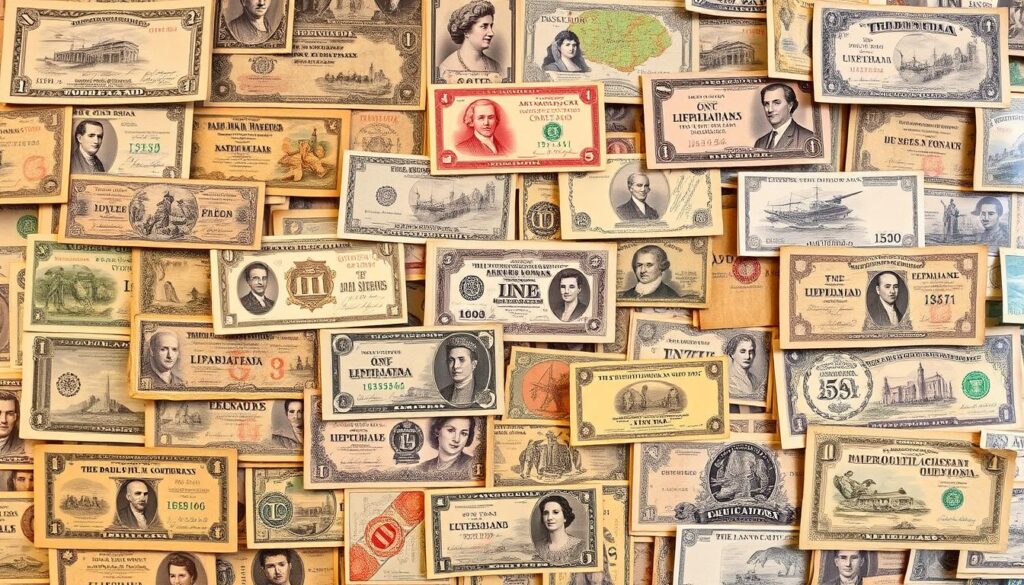
“The development of paper currency was a game-changer, revolutionizing trade and commerce across the globe.”
The evolution of paper money has had a lasting impact on the way we conduct business and facilitate economic exchange. As we continue to navigate the dynamic landscape of modern finance, the legacy of paper currency’s role in trade expansion remains a testament to the ingenuity and adaptability of human society.
Role of Banking Systems in Monetary Evolution
The establishment of banking systems, particularly central banks, played a pivotal role in the evolution of monetary systems. The creation of the Bank of England in 1694 marked a significant milestone in modern banking’s development. Central banks took control of currency issuance, regulating the money supply and ensuring economic stability.
This centralization of monetary authority had a profound impact on trade and economic policies, influencing global financial systems. As central banks emerged, they became the primary institutions responsible for implementing monetary policy and maintaining the financial institutions‘ economic stability.
The introduction of paper money, which evolved from receipts issued by goldsmiths, also played a crucial role in the transformation of monetary systems. Advancements in printing techniques, using specially prepared paper and various complementary processes, enhanced the security and durability of banknotes.
| Year | Monetary Development | Impact |
|---|---|---|
| 1260 | Paper money first implemented in China by Kublai Khan | Facilitated trade and commerce by providing a more convenient medium of exchange |
| 1694 | Bank of England established | Marked a significant development in modern banking, with central banks taking control of currency issuance and regulating the money supply |
| 1715 | King of France had a revenue of 165 million livres but needed an additional 50 million livres per year to pay interest on outstanding notes | Highlighted the challenges faced by governments in managing their monetary policy and economic stability |
| 2019 | Facebook unveils Libra, a new form of global digital currency | Signaled the ongoing transformation of monetary systems driven by technological advancements and the evolving role of financial institutions |
The evolution of banking systems and the centralization of monetary authority have played a crucial role in shaping the global financial institutions and economic stability. As central banks continue to guide the monetary policy, the banking sector remains at the forefront of the ever-changing landscape of money and trade.
Modern Trade and Digital Currency Transformation
The 21st century has witnessed a rapid transformation in currency and trade, driven by the advent of digital technologies. The rise of electronic payments and cryptocurrency has fundamentally altered the landscape of global commerce. With the introduction of Bitcoin in 2009, a new form of decentralized digital currency has emerged, challenging traditional monetary systems.
The growth of blockchain technology, which underpins cryptocurrencies, has enabled secure and transparent transactions, revolutionizing the way businesses and individuals engage in global commerce. Cryptocurrencies have reached new heights, with Bitcoin’s market capitalization peaking at over $1 trillion. As of January 2024, an estimated 130 countries, including the United States, are considering introducing their own central bank digital currencies (CBDCs) to compete with the cryptocurrency boom.
The adoption of digital currencies has been uneven, however. While an estimated 17 percent of U.S. adults have invested in, traded, or used cryptocurrency, less than 15 percent of people in El Salvador had used bitcoin as legal tender for paying taxes or debts in 2023. Nevertheless, the potential benefits of digital currencies, such as fast transfer times, reduced transaction costs, and global accessibility, especially for those without access to traditional banking systems, continue to drive their widespread adoption.
Despite the advantages, digital currencies face challenges, including storage and infrastructure demands, vulnerability to hacking, and volatility in value. The environmental impact of cryptocurrency mining, which consumes vast amounts of electricity, has also sparked concerns. As the industry evolves, balancing innovation and regulation will be crucial to ensuring the sustainable growth of digital currency and its integration into the future of global trade.
| Key Aspect | Impact |
|---|---|
| Bitcoin’s Market Capitalization | Peaked at over $1 trillion |
| Countries Considering Central Bank Digital Currencies | Estimated 130 countries, including the U.S. |
| U.S. Adults Invested in, Traded, or Used Cryptocurrency | Estimated 17 percent |
| El Salvadorians Using Bitcoin as Legal Tender | Less than 15 percent |
| Cryptocurrency Mining Electricity Consumption | Exceeds that of many countries |
“The rise of electronic payments and cryptocurrency has fundamentally altered the landscape of global commerce.”
Conclusion: Trade’s Lasting Impact on Money’s Evolution
The evolution of money has been intrinsically linked to the development of trade throughout history. From barter systems to digital currencies, each stage of monetary innovation has been driven by the needs of expanding commerce. The ongoing advancements in currency and payment systems continue to shape global trade patterns and economic structures, highlighting the enduring relationship between trade and monetary evolution.
Reflecting on the economic history, we can see how trade has repeatedly spurred breakthroughs in money, from the rise of commodity money to the introduction of official currencies and paper money. As trade routes expanded, so too did the need for more efficient and widely accepted mediums of exchange. The emergence of banking systems and credit-based currencies further illustrates how trade development has consistently fueled monetary innovation.
Looking ahead, the future of currency is poised to be significantly influenced by the dynamics of global trade. Digital currencies, blockchain technology, and other fintech advancements hold the potential to revolutionize how trade is conducted, streamlining transactions and reducing frictions. As the world becomes more interconnected, the interplay between trade and the evolution of money will undoubtedly continue to shape the economic landscape, underscoring the enduring impact of trade on the fundamental nature of currency.
FAQ
How long has money been a part of human history?
Money has been part of human history for at least 5,000 years. It evolved from barter systems to standardized currencies, facilitating trade and economic growth.
What was the primary form of trade before the invention of money?
Barter was the primary form of trade before the invention of money, involving direct exchange of goods and services. This system had limitations, including the need for a double coincidence of wants and difficulty in storing value.
What were some examples of early commodity money used in trade?
Early forms of commodity money included cattle, salt, and metal objects. These commodities were widely accepted and helped standardize value in trade.
How did the discovery and use of metals revolutionize currency?
The discovery and use of metals, particularly gold, silver, and copper, revolutionized currency. These precious metals became preferred due to their durability, divisibility, and rarity.
When did the first official currencies appear, and how did they impact trade?
The first coins resembling modern currency appeared in the 7th century BCE in Greece and Lydia. These early coins had fixed weights and values, bearing official seals. The use of standardized coinage facilitated long-distance trade and international commerce.
When did paper currency emerge, and how did it affect trade and economic expansion?
Paper currency emerged in China during the Yuan dynasty (1260 CE), as noted by Marco Polo. In Europe, paper money developed from goldsmith receipts in the Middle Ages. Paper money facilitated easier trade and economic expansion, allowing for more complex financial transactions and international trade.
How have digital technologies transformed currency and trade in the 21st century?
The 21st century has seen a rapid transformation in currency and trade with the advent of digital technologies. Mobile payments and electronic transfers have become commonplace, while cryptocurrencies like Bitcoin represent a new form of decentralized digital currency. These innovations are changing the nature of global trade and financial transactions.
