
The role of gold in the history of currency
Anúncios
Gold has long been a pivotal figure in the story of money and currency, shaping economic systems and global trade for centuries. Its unique properties, including its scarcity, durability, and ability to store value, have made it a prized asset throughout history.
From ancient civilizations to modern financial markets, gold’s influence on monetary policies and currency standards is undeniable.
The gold standard, a system that ties the value of a currency to the value of gold, was widely adopted by countries around the world, with England being the first to officially implement it in 1819.
The Bretton Woods Agreement of 1944 further solidified the role of gold, setting a fixed rate of $35 per ounce for converting the U.S. dollar to gold. However, the gold standard was ultimately abandoned, with President Nixon ending the convertibility of the U.S. dollar to gold in 1971.
Today, while gold no longer serves as the foundation for global currency, it maintains a significant presence in the financial system, with central banks and investors continuing to hold gold as a hedge against inflation and a safe haven asset. The history of gold as currency is a rich tapestry, interwoven with the evolution of global trade, economic policies, and the pursuit of wealth and stability.
Anúncios
Early Beginnings of Gold as Currency
The origins of gold as a medium of exchange can be traced back thousands of years. As early as 4000 BC, ancient civilizations in Eastern Europe were using gold to create decorative objects. Around 1500 BC, Egypt adopted gold as the first official currency for international trade, minting the Shekel coin weighing 11.3 grams.
The first known minted gold coins were produced in Lydia (modern-day Turkey) around 560 BC. These ancient Lydian staters were made of electrum, a natural alloy of gold and silver. Soon after, the Romans issued the Aureus gold coin in 50 BC, marking a significant step in the development of gold-based currency.
Over the centuries, the use of ancient gold coins as a commodity money system spread throughout the ancient world, from Persia to Greece and Rome. In 1284, Great Britain issued its first gold coin, the Florin, and in 1787, the United States struck its first gold coin, the Ephraim Brasher doubloon.
The adoption of gold as a standard for currency has had a profound impact on the global economy, shaping trade, commerce, and the financial systems of nations throughout history.
Gold’s Unique Properties as Money
Gold has long been prized for its unique properties that make it an ideal form of currency. Gold’s scarcity, malleability, durability, portability, divisibility, and have allowed it to supersede other commodities as a medium of exchange throughout history.
Gold’s scarcity is a key factor that gives it value. With only an estimated 190,000 tonnes in circulation and 54,000 tonnes that can be economically mined, gold’s limited supply ensures its rarity and desirability. Its malleability allows it to be easily shaped into coins, bars, and other forms, while its durability means it can withstand the test of time without degrading.
Crucially, gold’s portability makes it easy to transport and store, while its divisibility allows it to be divided into smaller units without losing its value. Finally, gold’s fungibility ensures that one unit of gold is interchangeable with another, making it a reliable and consistent form of currency.
“Of all the elements of the periodic table, gold is best suited for use as money due to its scarcity, malleability, durability, portability, divisibility, and fungibility.”
These unique properties have enabled gold to function as a store of value over long periods, preserving wealth and serving as a hedge against economic turmoil. The historical significance of gold as a monetary asset is a testament to its enduring importance in the global financial system.
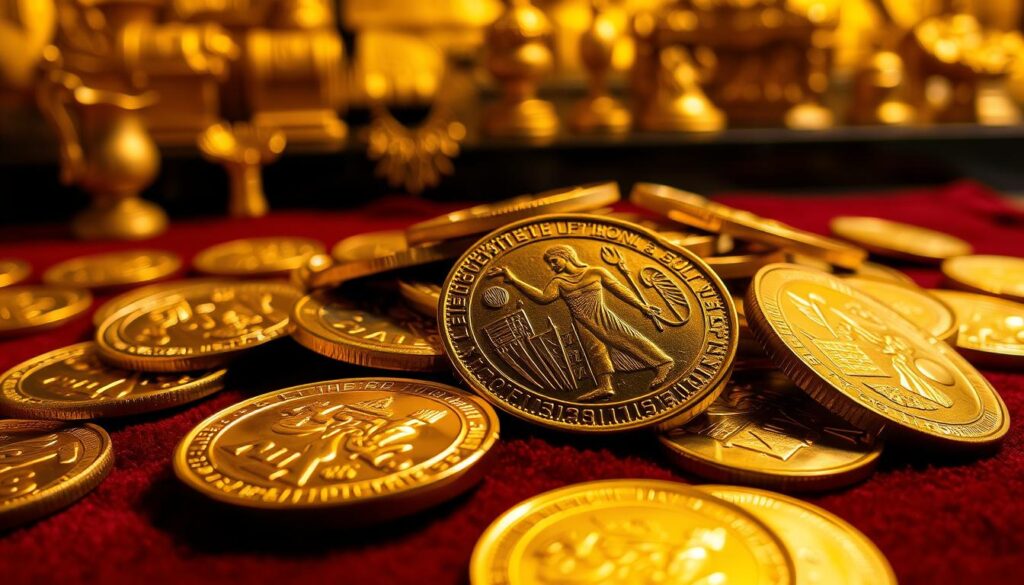
Ancient Civilizations and Gold Currency Systems
The history of currency is closely intertwined with the role of gold, which has been a vital component of global trade and economy for over 2,500 years. From the ancient Roman Empire to the powerful Byzantine and Ottoman Empires, gold coins have played a crucial part in shaping the financial landscape of the past.
The Roman Empire was among the first to widely use gold coins, with Julius Caesar introducing the aureus in the 1st century BC. This gold coin remained a fundamental part of the Roman monetary system until the 4th century AD, when Emperor Constantine replaced it with the gold solidus. The solidus would go on to survive the fall of the Western Roman Empire and continue to circulate in the Byzantine Empire, becoming a standard currency across the Mediterranean region.
The Byzantine Empire’s adoption of the gold solidus laid the groundwork for future currency systems. The Ottoman Empire, which rose to power in the 14th century, was heavily influenced by Byzantine monetary practices and introduced its own gold coin, the dinar. These ancient gold currency systems not only facilitated trade but also served as a symbol of power and prestige for the ruling empires.
The introduction of standardized gold coinage revolutionized global trade and commerce, paving the way for the widespread use of precious metals as a medium of exchange. The durability and luster of gold made it an ideal material for coins, and its association with currency can be traced back over 4,000 years to the ancient civilizations of the Lydians and Egyptians.
The legacy of these ancient gold currency systems continues to shape modern financial practices, with gold remaining a valuable store of value and a significant component of many countries’ foreign exchange reserves. The story of gold’s role in the history of currency is a testament to its enduring importance in the global economy.
The Role of Gold in the History of Currency
Gold has been a pivotal player in the history of currency, shaping the global economy and trade for millennia. One of the earliest examples of gold’s monetary significance dates back to 3,600 BC, when the Egyptians began using it to craft jewelry. This early association with wealth and prestige laid the groundwork for gold’s eventual rise as a medium of exchange.
The Florentine florin, introduced in 1252, marked a significant milestone in gold’s return to European currency systems. This decision enabled the city of Florence to thrive economically, as the florin became a dominant currency in Europe. Centuries later, the discovery of the New World by Spanish and Portuguese explorers led to an abundance of easily mined New World gold, significantly impacting global trade and currency systems. The Spanish silver dollar, or “pieces of eight,” emerged as a challenger to the florin’s dominance in Europe.
| Currency | Origin | Impact |
|---|---|---|
| Florentine florin | 1252 | Enabled Florence to thrive economically |
| Spanish silver dollar (“pieces of eight”) | New World discoveries | Challenged the florin’s dominance in Europe |
The role of gold in the history of currency is further underscored by the emergence of the Spanish real, a gold coin that became widely used in international trade. This, combined with the influx of New World gold, profoundly influenced the global economy, introducing new levels of wealth and enabling the expansion of global trade.

The enduring appeal of gold as a store of value and a reliable currency has been a constant throughout history. From the ancient civilizations to the modern era, gold’s unique properties, scarcity, and association with wealth have made it a coveted asset in the global financial system. As the world continues to evolve, the role of gold in the history of currency remains a fascinating and relevant topic of study.
Medieval Gold Standards and Trade
In the medieval era, the Italian city-states of Florence, Venice, and Genoa grew prosperous by leveraging their strategic positions along thriving trade routes with India and China. This influx of wealth enabled them to adopt gold as their monetary standard, minting their own gold coinage that became widely accepted across Europe and beyond.
The Florentine florin, introduced in 1252, swiftly rose to prominence as the dominant currency in much of the known world. Other European cities and states, such as Venice, soon followed suit by minting their own gold coins modeled after the florin. This proliferation of high-quality gold coinage facilitated international trade and economic growth throughout the medieval period.
| Key Developments in Medieval Gold Currency | Impact on Trade and Economic Growth |
|---|---|
|
|
The use of gold coinage in medieval Europe was a significant development that shaped the economic landscape of the time. By providing a stable and widely accepted currency, the Italian city-states and their gold standards played a crucial role in driving trade routes and economic growth throughout the continent.
“The Florentine florin became the most widely used currency in Europe, facilitating trade and commerce across the continent.”
The Classical Gold Standard Era
The classical gold standard era, spanning from the 1870s to the start of World War I in 1914, was a remarkable period of rapid economic growth, free movement of labor and capital, and global peace. By 1912, a remarkable 49 countries had adopted the gold standard, a system that encouraged high savings rates, capital accumulation, and industrial expansion. This era’s stability was rooted in the fixed exchange rates and the ‘price-specie flow mechanism’ proposed by economist David Hume, which linked a country’s money supply to its gold reserves.
Under the gold standard, central banks could influence market interest rates through tools like the discount rate to accelerate the adjustment process. The ‘rules of the game’ included maintaining fixed gold prices, allowing free gold exchange, and permitting unrestricted gold imports and exports. However, central banks sometimes violated these rules by sterilizing gold flows and manipulating gold points to impact trade.
The gold standard system functioned as a commitment mechanism, ensuring policymakers’ dedication to price stability. During this era, the average annual inflation rate was a mere 0.1% between 1880 and 1914, compared to 4.1% in the post-gold standard period from 1946 to 2003. The classical gold standard also exhibited lower short-term price instability, with a coefficient of variation of 17.0 for the U.S. between 1879 and 1913, compared to 0.88 for the later period.
However, the outbreak of World War I marked the end of this golden era for Europe, as belligerent powers abandoned the gold standard to finance their war efforts. Periodic attempts to revive the classical gold standard during the interwar period ultimately failed to survive the Great Depression of the 1930s, and no country currently operates on the gold standard today.
“The gold standard era, known as the ‘classical gold standard,’ was a remarkable period of rapid economic growth, free movement of labor and capital, and global peace.”
Britain’s Adoption of the Gold Standard
The history of currency is deeply intertwined with the role of gold, and one pivotal moment in this story is Britain’s adoption of the gold standard. In 1717, Isaac Newton, as master of the Royal Mint, set an exchange rate that effectively placed Britain on a gold standard. This move, largely by accident, would have lasting implications for the country’s currency and its position on the global economic stage.
The 1816 Coinage Act formally defined the pound sterling as a weight in gold, cementing Britain’s position on the gold standard for the next 200 years. This decision played a crucial role in stabilizing the value of the currency and establishing a fixed exchange rate, known as the bimetallic standard.
The adoption of the gold standard was driven by a desire for economic stability. By linking the currency’s value directly to gold, Britain sought to ensure the stability of its financial system and facilitate international trade. During the gold standard era, the range of fluctuation in the pound-dollar exchange rate was remarkably low, at around 1.3 percent in the 1880s.
However, the gold standard era was not without its challenges. The system faced limitations during economic downturns, as countries were unable to adjust their monetary policies to respond to changing economic conditions. This ultimately led to the gradual abandonment of the gold standard in the early 20th century, as countries sought more flexible exchange rate systems.
Despite these challenges, Britain’s adoption of the gold standard remains a significant milestone in the history of currency. It paved the way for a period of relative economic stability and influenced the global financial landscape for decades to come.
“The gold standard period saw nearly fixed exchange rates between countries on the standard, assured by profitable gold arbitrage when rates reached export or import points.”
America’s Journey to the Gold Standard
The United States’ relationship with the gold standard has been a complex and evolving one. Alexander Hamilton’s 1792 Coinage Act established a bimetallic standard, where the dollar was valued at 24.75 grains of gold and 371.25 grains of silver. This system saw adjustments in 1834, which effectively put the U.S. on a de facto gold standard by reducing the gold value of one dollar to 23.2 grains.
The path to a formal gold standard was not without resistance, as silver advocates pushed back against the idea. However, the Gold Standard Act of 1900 ultimately prevailed, officially establishing the gold standard in law and aligning the United States with other major economic powers of the time. This transition marked a significant milestone in the country’s monetary history and paved the way for further developments in the years to come.
The U.S. embrace of the gold standard was not without its challenges, as the nation navigated financial crises, such as the Panic of 1873 and the stock market crash of 1929. These events, along with policy decisions, ultimately led to the suspension of the fixed gold standard in 1933 and the transition to a fiat currency system under the Bretton Woods agreement in 1944. Despite these shifts, the U.S. dollar’s position as the world’s reserve currency has endured, highlighting the complex and evolving nature of America’s journey to the gold standard.
FAQ
What are the key properties of gold that made it a preferred currency?
How did ancient civilizations incorporate gold into their currency systems?
What role did gold play in the monetary systems of the Roman Empire and its successors?
How did the discovery of the New World impact global currency systems?
What was the significance of the classical gold standard era?
How did Britain and the United States transition to the gold standard?
