
The Forgotten Fortune of Genghis Khan: Where Did It Go?
Anúncios
Forgotten Fortune of Genghis Khan remains one of history’s most tantalizing enigmas, blending the sheer scale of imperial conquest with a silent, vanished legacy.
While other conquerors left behind gilded monuments or crumbling palaces, the Great Khan chose a path of absolute obscurity for his final rest.
This decision transformed his immense wealth from a physical treasury into a ghostly myth that haunts the steppes of modern Mongolia even today in early 2026.
Historical accounts suggest that his funeral procession was as blood-soaked as his military campaigns, designed specifically to hide his bones and gold.
Every person who witnessed the burial was reportedly executed to ensure the secret remained buried beneath the earth.
Anúncios
This strategic disappearance has fueled centuries of speculation, turning a historical fact into a legendary hunt for the world’s most elusive hidden treasure.
Highlights of the Mongol Mystery
- The Forbidden Zone: Why the Ikh Khorig remains a sacred and untouched archaeological site.
- Wealth Distribution: How the Mongol Empire prioritized military logistics over stagnant hoarding of gold.
- Scientific Search: Modern non-invasive technologies attempting to peer through the Mongolian soil.
- The Curse Factor: Cultural taboos that discourage the physical excavation of the Great Khan’s resting place.
Why did the Mongol Empire’s wealth vanish?
Genghis Khan ruled the largest contiguous land empire in human history, stretching from the Pacific Ocean to the gates of Central Europe.
Naturally, such an expansion gathered unimaginable riches, yet the Forgotten Fortune of Genghis Khan never appeared in the historical ledgers of later dynasties.
His wealth was not kept in a central bank but moved constantly within his mobile, nomadic military administration.
Unlike the Pharaohs of Egypt, the Mongols viewed stagnant wealth as a weakness that could slow down their horse-mounted armies.
They converted plundered gold into trade routes, diplomatic gifts, and better weaponry for their soldiers.
This fluidity ensured that when the empire eventually fractured, the gold had already dissolved into the global economy of the Silk Road.
What happened to the plunder from China?
Vast amounts of silver and silk flowed from the Jin and Xia dynasties into the hands of Mongol generals during the early thirteenth century.
Much of this Forgotten Fortune of Genghis Khan was distributed immediately among the soldiers as a reward for their unparalleled loyalty and bravery.
Nomadic traditions dictated that a leader’s greatness was measured by his generosity toward his followers, not by his personal hoard.
Consequently, the treasure was scattered across thousands of families, making it impossible for modern archaeologists to find a single “motherlode.”
++ The Rise and Fall of the “Richest Town” That No Longer Exists
How did the funeral hide the gold?
Legend states that eight hundred soldiers escorted the Khan’s body to its secret location and were subsequently killed by another group of warriors.
This second group was then executed by the imperial guard to ensure that no living soul knew the path to the grave.
If the Khan was buried with his treasures, they are protected by the most effective security system ever devised: total anonymity.
The landscape was allegedly trampled by ten thousand horses to erase any trace of a mound or a disturbed burial pit.
Where is the Ikh Khorig located?
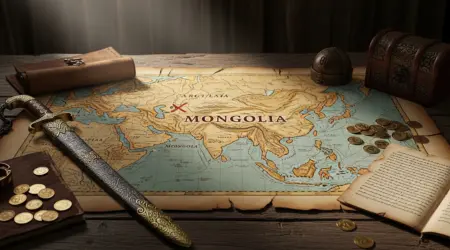
The “Great Taboo” or Ikh Khorig is a region in the Khentii Mountains believed to be the Khan’s final resting place.
For eight hundred years, this area was strictly off-limits to everyone except the darkhat, a tribe of elite warriors who guarded the site.
They prevented any intrusion, ensuring the Forgotten Fortune of Genghis Khan stayed undisturbed by grave robbers or curious travelers.
Today, the region remains largely protected by the Mongolian government, balancing modern tourism with deep respect for ancestral traditions.
While satellite imaging has identified interesting anomalies, the physical ground remains untouched by shovels.
Breaking this soil is considered a spiritual violation that could bring misfortune to the Mongolian nation and its people.
Also read: The Bizarre History of Life Insurance Policies on Strangers
Is the Burkhan Khaldun the real site?
Many historians point to Mount Burkhan Khaldun as the most likely location because Genghis Khan prayed there before his greatest victories.
Finding the Forgotten Fortune of Genghis Khan there would be like finding a needle in a haystack made of sacred mountains.
The sheer size of the mountain range makes a manual search nearly impossible without massive environmental destruction.
It remains a UNESCO World Heritage site, further complicating any intrusive archaeological efforts in the name of historical discovery.
Read more: How Ancient Egypt Taxed Beer — and Why It Worked
Can satellites find the hidden tomb?
National Geographic’s “Valley of the Khans” project used crowdsourced satellite analysis to identify thousands of potential archaeological sites in the region.
However, even these high-tech eyes cannot confirm the presence of gold or bones without ground-level verification.
Technology acts as a modern-day scout, but the Mongolian wilderness is an expert at keeping secrets.
Even in 2026, the dense forests and rocky terrain of the Khentii Mountains defy the most advanced thermal and ground-penetrating sensors.
How much was the Khan’s wealth actually worth?
Estimating the Forgotten Fortune of Genghis Khan is a difficult task because much of his wealth was expressed in land and human capital.
However, if we calculate the value of the precious metals seized from across Asia, the numbers reach into the hundreds of billions.
This wealth was like a rushing river that nourished the entire world rather than a stagnant pond in a palace basement.
It is important to remember that the Mongol economy was built on the flow of goods rather than the accumulation of bullion.
The Khan controlled the Silk Road, meaning he owned the very infrastructure of global trade.
His true fortune was the tax revenue and the peace the Pax Mongolica that allowed merchants to travel safely from London to Beijing.
What do modern statistics say about Mongol gold?
Research published in Nature regarding historical carbon levels suggests that the Mongol conquests were so vast they actually cooled the planet.
This environmental impact reflects a scale of power that suggests an equivalent scale of material wealth was under Mongol control.
The sheer volume of silver that disappeared from Persian and Chinese markets during this era remains a statistical anomaly for economic historians.
This Forgotten Fortune of Genghis Khan likely became the foundation for the currency systems of the successor Khanates.
Why is the search for the tomb controversial?
Many Mongolians feel that searching for the tomb is an act of Western disrespect toward a man they consider a demi-god.
They believe that if the Great Khan wanted his grave to be found, he would not have killed everyone involved in his burial.
Is the desire to find gold more important than respecting the final wish of a historical titan?
For the local population, the answer is a resounding no, as they prefer the legend to remain alive and the earth to remain silent.
Estimated Mongol Imperial Assets (1227 AD)
| Asset Category | Description | Modern Estimated Value |
| Livestock | Millions of horses, sheep, and camels | $50 Billion |
| Precious Metals | Gold and silver plundered from Asia | $200+ Billion |
| Land Control | 24 Million Square Kilometers | Incalculable |
| Trade Revenue | Silk Road Taxes and Tolls | $15 Billion / Year |
The Forgotten Fortune of Genghis Khan serves as a powerful reminder that some legacies are designed to be felt rather than seen.
His true treasure was the unification of nomadic tribes and the creation of a bridge between the East and the West.
While we may never find a pit filled with gold coins, the impact of his reign is visible in the DNA of millions and the maps of modern nations.
The secret of his grave remains the final victory of a man who conquered the world but chose to leave it without a trace.
What do you think is more valuable: the physical gold or the mystery that has lasted eight centuries?
Perhaps the secret itself is the greatest treasure he left behind. Share your thoughts and theories in the comments below!
Frequently Asked Questions
- Has anyone ever found a piece of the treasure?
- Small artifacts have been found across the empire, but never a concentrated hoard associated with the Khan’s personal burial.
- Why doesn’t the Mongolian government dig?
- Cultural sensitivity and the fear of desecrating a national hero outweigh the potential financial gain from a museum exhibit.
- Could the tomb be underwater?
- Some legends suggest a river was diverted over the grave to hide it, a tactic also rumored for other great ancient leaders.
- What is the “Curse of Genghis Khan”?
- Similar to the Pharaoh’s Curse, it is a belief that disturbing the Khan’s rest will trigger a global catastrophe or the end of the world.
- Is it true he died from a fall from a horse?
- This is one of many theories; others include battle wounds or illness during the final campaign against the Western Xia.
