
How Rich Were the Knights Templar — and Why It Got Them Killed

Anúncios
How Rich Were the Knights Templar is a question that has fueled centuries of treasure hunts, conspiracy theories, and academic debate within the realm of historical mythology.
At their peak, this military order operated as the world’s first multinational corporation, owning vast swaths of land across Europe and the Middle East.
Their financial power eclipsed that of many sovereign kings, creating a dangerous imbalance in the feudal hierarchy of the fourteenth century.
By mastering the art of the credit note, they transformed from humble monks into the most influential bankers in human history.
The Templar Financial Legacy
- The Birth of Banking: How the Order invented the modern letter of credit to protect pilgrims from roadside robbery.
- Vast Estates: Examining the network of farms, vineyards, and commanderies that fueled the Order’s massive war chest.
- Lenders to Kings: The political risk of becoming the primary creditor to the bankrupt monarchies of medieval Europe.
- The Great Purge: Analyzing the intersection of debt, heresy charges, and the sudden fall of the grand masters.
What was the true extent of the Templar wealth?
To understand How Rich Were the Knights Templar, one must look beyond gold coins to their immense portfolio of real estate and infrastructure.
Anúncios
They owned approximately 9,000 manors across Christendom, functioning like a modern hedge fund with diversified interests in agriculture and maritime trade.
Every commander oversaw a self-sustaining economic engine that funneled profits directly to the crusading efforts in the Holy Land.
This logistical brilliance allowed them to maintain a standing army that was better equipped and more disciplined than any national force.
How did they invent modern banking?
Pilgrims traveling to Jerusalem faced constant threats from bandits, making the transport of physical gold a suicidal endeavor for the average traveler.
The Templars solved this by allowing a traveler to deposit funds in London and withdraw them in Jerusalem using an encrypted receipt.
This revolutionary system of “ledger-based” wealth meant the Order controlled the flow of liquid capital across entire continents without moving a single chest.
It turned the knights into indispensable financial intermediaries, making them the silent architects of the burgeoning European economy.
++ How the Stock Market Was Once Run by Carrier Pigeons
Why did their tax-exempt status matter?
The Papacy granted the Order total exemption from all local taxes and tithes, a privilege that allowed their wealth to compound at staggering rates.
While local lords struggled with the costs of governance, the Templars reinvested every penny into expanding their naval fleet and fortress network.
This financial autonomy made them a “state within a state,” accountable only to the Pope, which naturally bred resentment among the secular nobility.
In the eyes of their rivals, the Templars were not just monks; they were an untouchable economic superpower.
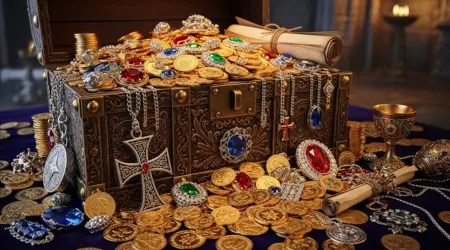
Why did their treasure lead to their destruction?
The reality of How Rich Were the Knights Templar eventually became their death warrant when King Philip IV of France found himself deeply in debt.
Philip had borrowed heavily to fund his wars with England, and the Templars were his largest and most demanding creditors.
Unable to pay his debts, the King realized that destroying the Order would not only cancel his loans but also allow him to seize their assets.
He weaponized rumors of secret rituals to justify a brutal crackdown that began on Friday the 13th, October 1307.
Also read: How Ancient Egypt Taxed Beer — and Why It Worked
What happened to the “missing” treasure?
When the King’s men raided the Paris Temple, they found far less gold than they expected, giving birth to the myth of the lost treasure.
Legend suggests the fleet at La Rochelle escaped with the Order’s most precious relics and remaining bullion before the arrests.
While historians argue that the “treasure” was mostly in the form of land deeds, the mystery of the missing coins persists in popular culture.
This vacuum of information has allowed modern myths about the Holy Grail and the Ark of the Covenant to flourish.
Read more: The Bizarre History of Life Insurance Policies on Strangers
How did debt influence the heresy trials?
King Philip used the Inquisition to force confessions of blasphemy, effectively turning a financial dispute into a spiritual crusade against the Order.
By painting the knights as enemies of God, he made it politically impossible for the Pope to continue protecting his favorite bankers.
The trials were a masterclass in political theater, where the goal was to liquidate the Order’s financial influence rather than find the truth.
Once the Grand Master, Jacques de Molay, was burned at the stake, the vast Templar network was officially dissolved.
Why does the Templar myth persist in 2026?
We remain fascinated by How Rich Were the Knights Templar because it mirrors our modern anxieties about concentrated wealth and hidden power.
In 2026, the image of the soldier-monk has transitioned from history into a cornerstone of the entertainment industry and digital folklore.
The idea that a secret organization once controlled the world’s money supply through hidden codes still resonates in our age of digital currencies.
They are the ultimate archetype of the “shadow elite,” representing both the pinnacle of organizational success and the tragic cost of greed.
How did they manage 9,000 properties?
Managing such a vast network required a level of literacy and accounting that was rare for the medieval period, setting them apart from the nobility.
They used standardized ledgers and reporting systems that ensured every vineyard in France supported the fortresses in Acre.
This administrative genius is often overlooked in favor of stories about swords and shields, but it was their pens that built the empire.
Their ability to track assets across borders was the true secret of their power, a feat not replicated until the modern era.
What is the statistical reality of their assets?
Modern researchers estimate that the Templars’ total assets would be worth billions in today’s currency, though much was tied up in non-liquid land.
According to historical records from the National Archives of France, the seizure of Templar lands provided a massive, albeit temporary, boost to the French royal treasury.
Despite the seizure, the French crown remained in financial turmoil, proving that the King’s greed far outweighed the actual liquid gold he recovered.
The tragedy of the Templars was that they were rich enough to be envied, but not powerful enough to survive a king’s betrayal.
Templar Economic Power vs. Feudal Rivals
| Asset Category | Knights Templar | Medieval Monarchs | Impact on History |
| Banking | International Letters of Credit | Localized Minting | Created global finance |
| Taxation | 100% Tax Exempt | Heavily Burdened | Rapid wealth accumulation |
| Real Estate | 9,000+ Commanderies | Fractured Territories | Integrated European trade |
| Navy | Professional Merchant Fleet | Requisitioned Fishing Boats | Dominated Mediterranean |
| Accountability | Only to the Pope | To Nobles and Church | Encouraged political envy |
The Price of Infinite Credit
The historical investigation into How Rich Were the Knights Templar reveals a sobering lesson about the fragility of power when it is built on the debts of others.
We have explored how their innovative banking systems made them indispensable, while their vast landholdings made them a target for a desperate and bankrupt king.
They were the pioneers of the financial world, turning the “pain of paying” into a streamlined digital receipt long before the internet existed.
Their fall was not caused by a lack of faith, but by a surplus of capital in a world where the sword still answered to the crown.
As we look at the ruins of their commanderies today, we see the remains of a dream that was too wealthy to be allowed to live.
Do you believe the legendary Templar treasure still exists in a hidden vault, or was it simply absorbed into the royal coffers of France? Share your experience in the comments!
Frequent Questions
Did the Templars really find the Holy Grail?
There is no historical evidence that the Templars ever possessed the Holy Grail or any other supernatural relics.
This part of their story is a later addition to their mythology, largely popularized by 18th-century Freemasonry and modern fiction like the “Da Vinci Code.”
How could a group of monks become so wealthy?
Their wealth began with massive donations from noble families who wanted to support the Crusades and earn spiritual favor.
Over time, their tax-exempt status and brilliant management of agricultural land turned these initial gifts into a self-multiplying fortune.
Is it true that Friday the 13th is unlucky because of the Templars?
While many people believe this, the connection between the arrest of the Templars on Friday, October 13, 1307, and the modern superstition is debated.
Most historians believe the superstition surrounding the date evolved much later from a combination of Christian and pagan folklore.
What happened to the knights who weren’t arrested?
Many fled to regions where the Papal bull was not strictly enforced, such as Scotland or Portugal.
In Portugal, the Order simply rebranded itself as the “Order of Christ,” continuing their naval traditions and eventually funding the Age of Discovery.
Could the Templars have survived if they had fought back?
Probably not. While they were elite warriors, they were scattered across hundreds of small commanderies and were taken by surprise.
Their vow of obedience to the Pope meant that once the Church withdrew its support, they lost their legal and moral right to exist.
