
The Curious Case of Money Printed for Places That Never Existed
Anúncios
Money Printed for Places That Never Existed fascinates numismatists and history buffs across the globe in 2026 because it exposes the fragile boundary between human imagination and official economic value.
While central banks today debate central bank digital currencies and algorithmic monetary policy, archival vaults still hold physical banknotes issued for utopian islands, imaginary kingdoms, and phantom principalities that never appeared on any legitimate map.
Collectors pay staggering sums for these crisp pieces of paper, proving that trust and storytelling often carry more weight than sovereign borders or gold reserves.
Understanding how these phantom bills entered circulation reveals a hidden chapter of financial history where fraudsters, idealists, and desperate governments blurred reality with fiction.
Have you ever wondered why an educated investor would trade real silver or gold coins for paper currency backed by a desert mirage or a fictional island nation?
Anúncios
That exact psychological trigger fueled some of the most audacious financial schemes and idealistic social experiments of the past two centuries.
When people desperately want to believe in sudden prosperity or a perfect society, crisp engraving and official-looking seals easily override rational skepticism.
Exploring these historical episodes shows how easily visual authority creates perceived value out of thin air.
In this article, you will explore:
- What historical conditions allowed authorities and con artists to issue banknotes for fictional territories
- How legendary examples like Gregor MacGregor’s Poyais and Joseph Zwicky’s imaginary states operated in real markets
- Why modern collectors in 2026 treat these phantom currencies as blue-chip numismatic assets
- Key differences between fraudulent fantasy banknotes, micronation scrip, and theatrical movie money
- Answers to the most common questions regarding the legality, valuation, and authentication of fictional currency
What Is the History Behind Money Printed for Places That Never Existed?
Why Did Nineteenth-Century Fraudsters Print Banknotes for Fictional Countries?
Money Printed for Places That Never Existed reached its peak during the early nineteenth century, when rapid colonial expansion created massive information gaps between European financial hubs and distant territories.
Investors in London and Paris routinely funded overseas ventures without any reliable way to verify geographical claims before ships crossed the Atlantic.
Scammers exploited this communication lag by hiring top-tier security printers to produce authentic-looking government bonds, land deeds, and paper currency.
Because the engraving quality matched notes issued by the Bank of England, wealthy aristocrats and working-class families alike trusted the paper implicitly.
This era demonstrated that sophisticated printing technology could manufacture national credibility overnight.
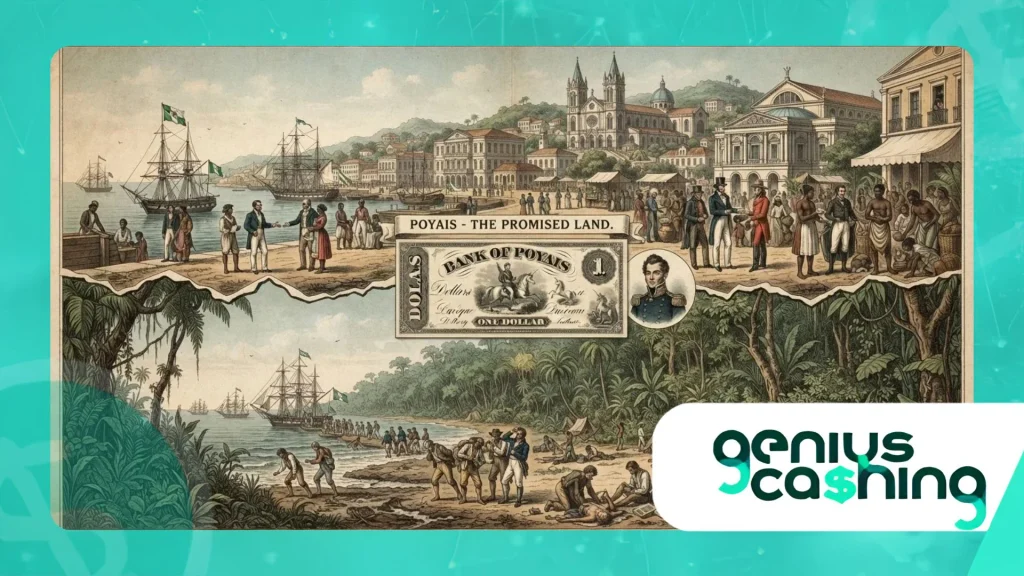
Consider the notorious 1822 scheme orchestrated by Scottish soldier Gregor MacGregor, who invented the Central American nation of Poyais out of whole cloth.
MacGregor claimed to be the Cacique, or prince, of a fertile, developed territory along the Mosquito Coast complete with an opera house, a cathedral, and a thriving banking system.
He commissioned Edinburgh security printers to produce official Bank of Poyais banknotes denominated in dollars, persuading hundreds of settlers to exchange their life savings for worthless paper.
When the first ships arrived in Central America in 1823, settlers found only uninhabited jungle, resulting in a humanitarian disaster where over two-thirds of the colonists perished.
How Did Utopian Movements Create Currency for Imaginary Lands?
Not every phantom currency stemmed from malicious fraud, as many nineteenth-century reformers printed banknotes for idealized communities that existed only on architectural blueprints.
Social philosophers across Europe and North America believed that replacing gold-backed money with labor-backed paper notes could eliminate poverty and class conflict.
These visionaries established theoretical nations and cooperative commonwealths, printing intricate bills meant to circulate once their model cities materialized.
Even though most of these settlements never broke ground, the surviving banknotes remain tangible artifacts of radical economic idealism. They illustrate how monetary design often serves as a canvas for political dreams.
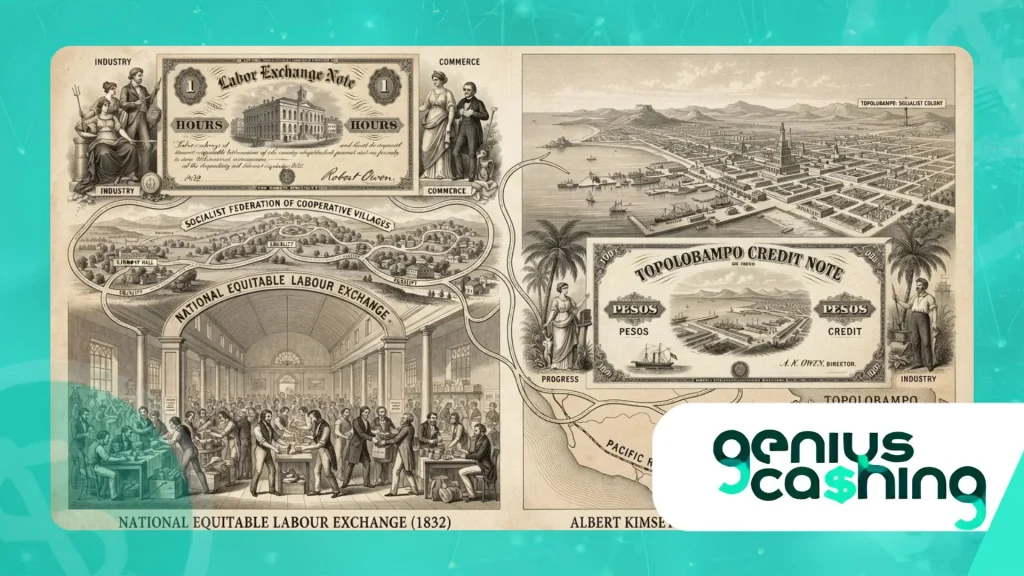
In 1832, British industrialist and reformer Robert Owen launched the National Equitable Labour Exchange in London, issuing ornate notes denominated in hours of labor rather than pounds sterling.
While the exchange operated briefly in physical halls, its broader vision relied on an imaginary global federation of self-sustaining cooperative villages that never materialized.
Similarly, in the late 1800s, American writer Albert Kimsey Owen designed Topolobampo, a theoretical socialist metropolis in Mexico, complete with printed credit notes for infrastructure that remained largely unbuilt.
Both ventures relied on the premise that circulating currency could physically manifest a non-existent civilization.
++ How Forgotten Banknote Plates Helped Expose Counterfeit Schemes
What Role Did Security Printers Play in Legitimizing Phantom Nations?
Nineteenth- and twentieth-century banknote engraving companies operated as private commercial enterprises that rarely vetted the geopolitical legitimacy of their paying clients.
Firms like Perkins, Bacon & Petch in London or the American Bank Note Company in New York possessed intaglio printing presses capable of rendering intricate geometric lathe work and classical allegories.
When a charismatic envoy arrived with gold coins to pay for plate engraving, printers fulfilled the order without consulting foreign ministries.
Consequently, banknotes for imaginary realms featured the exact same watermarked paper and anti-counterfeiting microprint as genuine sovereign tender. That technical parity erased visual doubts among everyday users.
Imagine walking into a modern bank and receiving a crisp bill printed on official cotton-linen security paper with holographic strips, only to learn the issuing country sits entirely inside a novelist’s imagination.
For nineteenth-century merchants, holding an intaglio-printed note felt identical to holding sovereign debt from France or Spain.
Printers inadvertently acted as credibility launderers, lending centuries of institutional prestige to pure fiction.
Without the cooperation of established security engravers, Money Printed for Places That Never Existed would never have fooled sophisticated bankers on the London Stock Exchange.
How Do Famous Examples of Fictional Banknotes Compare in Real History?
How Did Gregor MacGregor Pull Off the Infamous Poyais Currency Scam?
Gregor MacGregor elevated financial deception into high art by constructing an entire literary and bureaucratic ecosystem around his fictional principality of Poyais.
Before selling a single banknote, he published a 355-page guidebook under a pseudonym detailing Poyaisian climate, laws, parliamentary structure, and mineral wealth.
He opened official legations in London, Edinburgh, and Glasgow, where clerks solemnly exchanged British pounds for Bank of Poyais notes at par value.
By creating a closed loop of self-reinforcing documentation, MacGregor convinced rational merchants that his paper money represented a booming overseas economy. Investors bought the story long before they examined the paper.
According to archival records maintained by the British Library and Bank of England Museum, MacGregor raised roughly 200,000 British pounds in bonds and currency exchanges during 1822 and 1823.
Adjusted for modern purchasing power in 2026, that sum equals well over 25 million pounds sterling extracted from ordinary citizens for a country that never existed.
Even after surviving settlers returned to Britain and exposed the fraud in London newspapers, several victims publicly defended MacGregor, blaming incompetent ship captains rather than questioning the reality of Poyais. His banknotes remain the gold standard of numismatic fraud.
++ Curiosities About Billionaires Who Refused Luxury Lifestyles
What Was the Story Behind the Kingdom of Araucanía and Patagonia Currency?
In 1860, French lawyer Orélie-Antoine de Tounens traveled to southern Chile and proclaimed himself King of Araucanía and Patagonia, a vast territory spanning Indigenous Mapuche lands that never achieved international recognition.
Although Chile and Argentina actively governed and contested the region, Tounens drafted a constitution, designed a national flag, and established royal ministries in exile in Paris.
During the late nineteenth century, successive pretenders to the Araucanian throne printed official-looking peso banknotes bearing royal crests and portraits.
These notes circulated among Parisian supporters and sympathizers who funded diplomatic missions for a kingdom lacking sovereign borders.
Unlike MacGregor’s purely predatory scheme, the Kingdom of Araucanía and Patagonia operated as an enduring political fantasy sustained across generations by romantic European royalists.
Numismatic catalogs document multiple series of Araucanian banknotes printed between 1874 and the early twentieth century, denominated in pesos and centavos.
None of these bills ever purchased bread in Patagonia, yet they functioned as membership tokens and fundraising instruments within European salons.
Today, collectors prize these specimens because they capture the intersection of colonial ambition, personal delusion, and theatrical statecraft.
Also read: The Most Expensive Business Handshake Ever Recorded
Why Did Twentieth-Century Micronations Issue Notes for Imaginary Territories?
During the second half of the twentieth century, the motivation behind Money Printed for Places That Never Existed shifted from colonial fraud toward conceptual art, tax protest, and satirical commentary.
Artists and eccentric libertarians declared uninhabited ocean shoals, abandoned World War II sea forts, and backyard plots as independent nations.
They commissioned custom banknotes featuring whimsical national symbols, fictional heads of state, and playful denominations to challenge traditional definitions of sovereignty.
By mimicking the visual language of central banks, these creators forced observers to question why ordinary people trust state-issued fiat money.
A prime example emerged in 1968 when Italian engineer Giorgio Rosa built a 400-square-meter concrete platform in the Adriatic Sea just outside Italian territorial waters, naming it the Republic of Rose Island.
Although Rosa issued stamps and declared Esperanto the official language, the Italian navy demolished the platform in 1969 before its planned currency, the Mill, achieved broad circulation.
Similarly, conceptual artists in the 1990s printed banknotes for the fictitious Kingdom of Elgaland-Vargaland, claiming sovereignty over all border territories and mental states.
These modern examples prove that fictional currency thrives wherever human creativity challenges bureaucratic authority.
Why Do Collectors Value Phantom Currency Today?
What Makes Banknotes from Non-Existent Places Valuable in 2026?
In the 2026 numismatic market, authentic historical banknotes from fictional places command prices that frequently surpass genuine currency from the same era.
Scarcity drives much of this demand, because victims of financial frauds often burned or discarded their worthless bills out of shame once the schemes collapsed.
Surviving specimens from Poyais or nineteenth-century utopian colonies exist in tiny quantities, often preserved accidentally inside court evidence files or estate archives.
Furthermore, crossover appeal attracts both traditional paper money specialists and collectors of historical true crime, cartography, and political memorabilia. High auction prices reflect the enduring power of a compelling backstory.
Major auction houses in London and New York regularly feature fantasy and phantom banknotes in dedicated numismatic sales, where uncirculated Poyais notes routinely fetch several thousand dollars apiece.
Third-party grading services like Paper Money Guaranty authenticate and encapsulate these items, assigning population reports that verify their extreme rarity.
Collectors recognize that while an ordinary nineteenth-century provincial banknote documents routine commerce, a phantom note captures a dramatic moment of human audacity.
As digital transactions replace physical cash in everyday life during 2026, tangible artifacts of monetary history grow increasingly desirable.
How Do Experts Authenticate Genuine Historical Fantasy Banknotes?
Authenticating Money Printed for Places That Never Existed requires forensic precision because modern souvenir reprints frequently flood online marketplaces.
Numismatic experts begin by examining paper composition under ultraviolet light to confirm nineteenth-century rag-cotton fiber content rather than modern wood-pulp paper.
Next, specialists inspect the intaglio engraving lines under high magnification, verifying whether the ink sits raised above the paper surface in the distinct manner of hand-engraved steel plates.
Authentic historical specimens also display period-accurate iron-gall ink signatures and hand-numbered serial stamps applied by clerks at the time of issue.
Comparing suspect notes against archival printer proof books held by institutions like the British Museum or Smithsonian Institution provides definitive verification.
Security printing firms kept meticulous ledgers containing sample impressions of every plate they engraved, including orders placed by dubious sovereigns.
When a collector submits a rare phantom note for certification, authenticators match micro-engraving details against those original printer records.
This rigorous process protects buyers from twentieth-century tourist reproductions while preserving the historical integrity of genuine numismatic curiosities.
How Does Phantom Currency Differ from Movie Money and Micronation Scrip?
| Category | Historical Phantom Country Notes | Modern Micronation Currency | Theatrical & Prop Movie Money |
| Primary Purpose | Financial fraud, investment scams, or utopian fundraising | Satire, conceptual art, protest, or souvenir sales | Film production, television, and stage performances |
| Issuing Entity | Convincing front banks or self-proclaimed royalty | Artists, hobbyists, or unrecognized micro-states | Motion picture prop houses and graphic designers |
| Geographic Claim | Fabricated lands or unowned territories claimed as real | Backyards, ocean platforms, or abstract conceptual spaces | Explicitly fictional cities or altered real denominations |
| Printing Quality | High-end intaglio engraving by legitimate security firms | Offset lithography, digital print, or polymer substrates | Standard commercial offset printing with disclaimers |
| 2026 Collector Value | High ($500 to $10,000+ depending on rarity and grade) | Low to moderate ($5 to $150 for limited artist runs) | Low ($1 to $50 unless screen-used in iconic films) |
Distinguishing historical phantom currency from modern prop money and micronation tokens helps collectors avoid costly misidentifications.
Historical phantom notes were specifically engineered to deceive contemporary investors or build genuine utopian economies, relying on legitimate security printers to pass as sovereign tender.
Conversely, theatrical prop money carries legal disclaimers and intentionally avoids exact replication to comply with anti-counterfeiting statutes worldwide.
Modern micronation currency sits squarely between both worlds, celebrating its own fictional status openly rather than hiding behind deceptive prospectuses.
Each category reflects a distinct relationship between money, law, and imagination.
The Enduring Power of Financial Storytelling
History proves that Money Printed for Places That Never Existed succeeds whenever narrative persuasion outpaces due diligence.
From Gregor MacGregor’s tragic Poyais deception to Robert Owen’s idealistic labor notes and twentieth-century artistic micronations, these artifacts reveal that all currency ultimately rests on shared human belief.
Paper bills hold zero intrinsic value without collective confidence backing the institutions that print them.
Examining these forgotten currencies reminds modern investors in 2026 to look past polished branding and verify the real-world fundamentals behind every financial promise.
Have you ever encountered an unusual piece of historical scrip or fictional currency in a museum or private collection? Share your thoughts and discoveries in the comments below.
Frequently Asked Questions
Was it illegal to print money for a country that did not exist?
In the nineteenth century, printing banknotes for a fictional nation rarely violated counterfeiting laws because counterfeiting statutes only prohibited imitating existing sovereign currencies.
Authorities prosecuted figures like Gregor MacGregor for fraud and obtaining money under false pretenses rather than illegal currency production.
Today, international laws strictly prohibit designing fictional notes that closely resemble active legal tender like the US dollar or Euro.
Which is the most famous banknote ever printed for a non-existent country?
The 1822 Bank of Poyais dollar notes issued by Scottish adventurer Gregor MacGregor remain the most famous examples in numismatic history.
Printed in Edinburgh by legitimate security engravers, these bills financed a massive colonization scam in Central America.
Surviving examples reside in the British Museum and top private collections worldwide.
Can you still buy authentic banknotes from fictional countries in 2026?
Yes, collectors can acquire authentic historical phantom banknotes through reputable numismatic auction houses, specialized currency dealers, and certified online marketplaces.
Buyers should always look for third-party authentication from recognized grading services to ensure the note is an original period printing rather than a modern souvenir reproduction.
How can you tell the difference between a real Poyais banknote and a modern reprint?
Original 1822 Bank of Poyais notes feature hand-engraved intaglio printing on watermarked rag paper, producing raised ink ridges that you can feel with your fingertips.
They also include genuine hand-written serial numbers and iron-gall ink signatures that turn brownish over two centuries. Modern reprints use flat offset or digital printing on smooth, bright white wood-pulp paper.
Why did legitimate printing companies agree to print money for fake countries?
Nineteenth-century security printing firms operated as commercial businesses that prioritized paying clients over geopolitical verification.
Because global communication took months by sailing ship, printers had no practical way to confirm whether a distant overseas territory possessed a legitimate government.
As long as a client paid upfront in gold or British pounds, engravers delivered standard sovereign-grade banknotes.
