
How Ancient Merchants Built Fortunes Without Banks
Anúncios
How ancient merchants built fortunes without banks remains one of history’s most fascinating financial triumphs, revealing how early traders mastered global commerce, complex risk management, and credit creation long before modern financial institutions existed.
In an era devoid of central vaults or digital wire transfers, intrepid entrepreneurs across Mesopotamia, the Silk Road, and the Mediterranean designed ingenious decentralized systems to move immense wealth across thousands of miles.
By relying on sophisticated private networks, legal codes, physical ledger systems, and deep-seated social trust, these historical visionaries turned raw commodities into massive commercial empires.
Today, modern financial analysts and blockchain pioneers increasingly study these ancient mechanics to understand the foundational principles of peer-to-peer liquidity and trustless transactions.
Key Topics Covered
Anúncios
- How Early Commerce Flourished Without Banking Infrastructure
- Why Trust and Private Contracts Replaced Central Financial Institutions
- What Mechanisms Allowed Wealth Distribution Across Ancient Trade Routes
- Historical Data on Ancient Trade Networks
- Strategic Lessons for Modern Decentralized Finance
- Frequently Asked Questions
How Did Early Traders Manage Capital Without Modern Financial Infrastructure?

Long before institutional banking existed, ancient merchants built fortunes without banks by converting tangible commodities into standardized units of value and establishing private credit arrangements.
In ancient Mesopotamia, merchants used barley and silver ingots by weight as universal mediums of exchange, recording obligations on durable cuneiform clay tablets that functioned as legally binding promissory notes.
According to research published by the Oriental Institute of the University of Chicago, thousands of surviving administrative clay tablets from Old Assyrian trading colonies like Kanesh show that 18th-century BCE traders routinely issued interest-bearing loans and managed complex partnership accounts across hundreds of miles without a single central bank involved.
These early entrepreneurs realized that carrying massive amounts of physical bullion across treacherous terrain was far too dangerous and inefficient for large-scale operations.
To solve this, they created sophisticated peer-to-peer credit systems where trade debt could be transferred, offset, or cleared through trusted family proxies and merchant guilds.
Think of these clay ledger systems like an offline, physical precursor to modern distributed ledgers, where every transaction was witnessed, stamped with personal cylinder seals, and stored in community archives to guarantee enforceability.
What Role Did Commodities Play in Ancient Liquidity?
Commodities functioned as the lifeblood of early trade liquidity, serving as both immediate mediums of exchange and reliable stores of long-term value.
Grain, textiles, salt, and precious metals carried intrinsic utility, allowing traders to settle large accounts across different regions without relying on standardized government coinage.
Traders carefully calculated conversion rates between perishable goods and durable metals, creating dynamic local exchange markets that fueled international expansion.
This pragmatic reliance on real-world asset backing ensured that commerce remained resilient even during periods of political instability or monarchical collapse.
++ Why Ancient Merchants Were Richer Than Some Modern Nations
How Were Promissory Notes Executed on Clay Tablets?
Promissory notes were meticulously drafted on wet clay tablets, specifying the exact debt amount, repayment terms, interest rates, and authorized guarantors.
Once written, the tablet was enclosed in a protective clay envelope, sealed with the unique cylinder seals of all participating parties to prevent tampering.
If a dispute arose, elders or merchant councils would break open the outer clay envelope to verify the unaltered contract hidden inside.
This ingenious tamper-evident design allowed debts to be safely bought, sold, and transferred between independent merchants across long distances.
Why Did Trust and Private Guilds Replace Institutional Banking Systems?
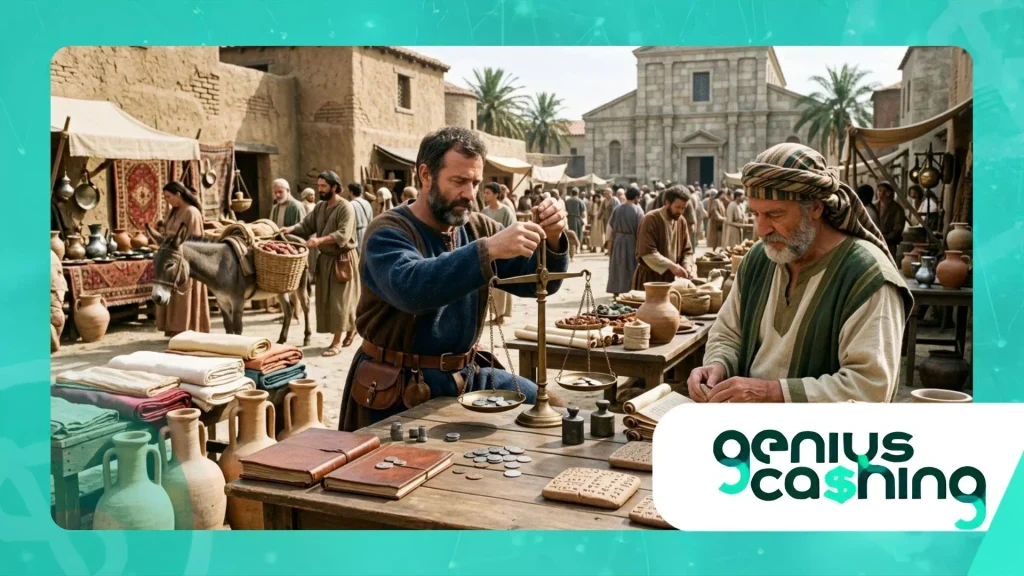
Building vast commercial wealth required robust mechanisms to enforce contracts and prevent fraud across distant borders where local monarchs held no jurisdiction.
Ancient merchants solved this governance challenge by establishing tight-knit merchant guilds, diaspora trade networks, and strict codes of reputation-based self-regulation.
If a trader breached a contract in a distant port, their reputation was permanently ruined, effectively banishing them from future commercial opportunities across the entire known trading network.
To further minimize risk, merchants constructed sophisticated informal partnerships known as the commenda in the medieval Mediterranean or naruqqum in ancient Assyria, pooling capital from multiple silent investors to finance high-risk ventures.
By distributing financial risk across dozens of investors, ancient merchants built fortunes without banks while insulating individual capital holders from catastrophic losses due to shipwreck, banditry, or crop failures.
Also read: Why Do So Many Billionaires Wear the Same Clothes Every Day?
How Did Reputation Enforce Legal Contracts Across Borders?
In the absence of international courts, a merchant’s personal reputation was their most valuable commercial asset and primary financial collateral.
Information regarding defaulted debts or unethical behavior traveled rapidly along trade routes via regular correspondence letters, instantly isolating bad actors.
This harsh community-enforced banishment created a powerful self-policing incentive that kept contract breach rates remarkably low across international borders.
Consequently, trust operated as a tangible economic asset, lowering transaction costs and eliminating the need for expensive institutional intermediaries.
Read more: Why Do So Many Billionaires Wear the Same Clothes Every Day?
How Did Risk-Sharing Partnerships Protect Capital?
Ancient risk-sharing partnerships allowed active traders to seek investment capital from multiple passive backers who shared both profits and potential losses.
Under these contractual agreements, if a cargo ship sank during a storm, financial losses were divided proportionally among all pool participants rather than bankrupting a single merchant.
This collective capital structure encouraged daring exploratory trade expeditions into uncharted territories with high profit margins.
Modern venture capital funds and investment syndicates still rely on this exact same structural blueprint to manage high-risk financial endeavors today.
What Mechanisms Allowed Wealth Distribution Across Long Trade Routes?
Moving wealth along the Silk Road or Mediterranean maritime routes required ingenious transfer mechanisms that eliminated the need to carry physical coin.
Italian merchants in the late Middle Ages perfected the bill of exchange (lettera di cambio), allowing a merchant to deposit money with a banker in Florence and draw equivalent funds in another currency from a correspondent merchant in Bruges.
Similarly, Islamic merchants utilized the hawala system, an informal honor-based value transfer network that allowed immense fortunes to move across continents instantly without physical cash movement.
These decentralized financial mechanisms functioned seamlessly because the participating agents maintained balancing accounts with one another, periodically clearing net debts through commodity shipments or silver transfers.
Through these interconnected private clearinghouses, ancient merchants built fortunes without banks and laid the structural foundation for modern global trade finance.
How Did the Hawala System Move Value Without Physical Cash?
The hawala network operated through a decentralized grid of trusted brokers who honored payment orders based entirely on mutual trust and unwritten honor codes.
A merchant in Baghdad could hand cash to a local broker, receive a secret passcode, and instruct a business partner in India to collect the funds from a local Indian broker using that code.
The two brokers would then balance their resulting ledger debt through future trade goods or counter-transactions, completely avoiding the immense hazards of highway robbery.
This system was so remarkably efficient and resilient that it remains widely actively utilized across global trade networks today.
How Did Bills of Exchange Protect Transcontinental Wealth?
Bills of exchange functioned as both a credit instrument and a sophisticated foreign currency exchange contract written on simple paper slips.
They allowed international traders to purchase goods abroad on credit while bypassing religious prohibitions against traditional interest charges by embedding financing costs within currency conversion markups.
By eliminating the necessity of transporting heavy chests of gold across pirate-infested seas, bills of exchange exponentially increased the velocity of international capital.
Merchants could reinvest their preserved capital into multiple ongoing ventures simultaneously, compounding their overall wealth at unprecedented speeds.
Historical Comparison of Ancient Financial Systems
The structural mechanics utilized by historical trading cultures demonstrate how private commercial innovation consistently outperformed non-existent state banking infrastructure.
| Region & Era | Primary Credit Tool | Risk Mitigation Strategy | Enforcement Mechanism |
| Mesopotamia (1800 BCE) | Encased Clay Promissory Notes | Joint-Stock Pool (Naruqqum) | Cylinder Seals & Civic Council |
| Mediterranean (1200 CE) | Bill of Exchange (Lettera) | Maritime Commenda Contracts | Merchant Guild Excommunication |
| Middle East/Asia (800 CE) | Informal Ledger Transfers (Hawala) | Distributed Broker Balance | Family Honor & Code of Conduct |
| Greco-Roman (200 BCE) | Bottomry & Resp. Loan Contracts | Hull & Cargo Syndication | Praetorian Commercial Courts |
The Timeless Wisdom of Autonomous Financial Architecture
Examining how ancient merchants built fortunes without banks demonstrates that successful commerce relies fundamentally on trust, clear ledger record-keeping, and smart risk distribution rather than physical brick-and-mortar financial institutions.
Long before central banks regulated money supply or digital servers processed payments, historical trading communities constructed resilient, self-governing financial ecosystems that powered global trade for millennia.
As modern commerce increasingly pivots toward decentralized finance, peer-to-peer networks, and cryptographic ledgers, we are essentially rediscovering and modernizing the very principles engineered by ancient traders thousands of years ago.
By studying these timeless financial frameworks, modern entrepreneurs can build more resilient, adaptable, and efficient trade networks capable of thriving without total reliance on traditional banking intermediaries.
What ancient trade strategies do you think could be applied to modern digital business? Share your thoughts in the comments below!
Frequently Asked Questions
How did ancient merchants calculate interest rates without formal bank formulas?
Interest rates were calculated using traditional fixed ratios based on seasonal agricultural yields or local trade customs.
For example, Mesopotamian law codes established standard benchmark interest rates for silver and grain loans, allowing merchants to easily calculate returns based on time and crop harvest cycles without complex banking software.
What happened when an ancient merchant defaulted on a private credit agreement?
When an ancient merchant defaulted on a private debt agreement, local commercial councils or guild elders enforced penalties according to local customary law.
Punishments ranged from the seizure of pledged collateral assets and family property to complete commercial banishment, which effectively ended the merchant’s ability to conduct future trade business within the region.
Were ancient non-bank financial systems vulnerable to systemic fraud?
While fraud occurred occasionally, ancient non-bank systems minimized systemic risk through tight-knit personal networks, public record archives, and tamper-evident technology like sealed clay envelopes.
Because business relied heavily on personal reputation and verified family proxies, dishonest actors were quickly identified, isolated, and permanently excluded from trade networks before causing widespread financial contagion.
Did ancient governments regulate these private non-bank merchant networks?
Ancient governments periodically issued legal framework guidelines, such as the famous Hammurabi Code, which set legal interest rate caps and established formal rules for contract validity.
However, rulers generally allowed private merchant networks to self-govern their day-to-day international operations because these trade routes generated vital tax revenue and essential luxury goods for the empire.
How did ancient merchants built fortunes without banks during wartime?
During periods of war or severe geopolitical conflict, ancient merchants shifted trade routes, converted liquid capital into highly portable commodities like gold, precious gems, or silk, and relied heavily on decentralized value transfer networks like the hawala.
By avoiding centralized vaults and fixed geographic infrastructure, these agile traders protected their assets and continued operating across hostile borders regardless of political upheaval.
