
The evolution of money: From barter to cryptocurrency
Anúncios
Money has been an integral part of human civilization for thousands of years, evolving from the earliest forms of barter trade to the sophisticated monetary systems we know today.
The concept of money serves three primary functions: as a medium of exchange, a store of value, and a unit of account. This article explores the fascinating journey of money, from ancient civilizations to the digital age, highlighting key developments and their impact on society and the global economy.
Throughout history, various forms of money have emerged, shaped by the needs and advancements of different societies. From the use of commodities like salt, shells, and silk in ancient times to the minting of the first official currency, the Lydian stater, in 600 BCE, money has undergone a remarkable transformation. The transition from metal coins to paper money, which occurred in China during the Yuan dynasty in 1260 CE, marked a significant milestone in the evolution of monetary systems.
The shift to paper currency enabled the expansion of international trade, leading to the emergence of the first currency markets and currency wars. As the world continued to evolve, mobile payments came to prominence in Asia and Europe before reaching North America, allowing for transactions via smartphones and tablets. Today, the rise of cryptocurrency, such as Bitcoin, has introduced a new paradigm in the world of finance, offering a decentralized digital currency option as an alternative to state-controlled fiat money and traditional commodity-backed currencies.
From the barter systems of ancient civilizations to the cutting-edge blockchain technology powering cryptocurrencies, the evolution of money has been a fascinating journey, reflecting the ingenuity and adaptability of human societies. As we delve deeper into this captivating history, we gain a better understanding of the role of money in shaping economic development and its continued impact on our global financial landscape.
Anúncios
Understanding the Fundamentals of Exchange Systems
The evolution of economic principles has been a fascinating journey, marked by the development of various exchange systems. At the core of these systems lies the fundamental concept of value exchange, which has undergone a remarkable transformation over time.
The earliest form of trade was the barter system, where goods and services were directly exchanged without the use of a standardized currency. While this method allowed for the fulfillment of basic needs, it was hampered by the need for a “double coincidence of wants” – the challenge of finding two parties who each desired the other’s offerings.
As economic interactions grew in complexity, the limitations of the barter system became more apparent. The lack of a standardized measure of value and the issues with divisibility and wealth storage paved the way for the emergence of more sophisticated trade mechanisms.
The introduction of commodity money, such as precious metals, marked a significant milestone in the history of economic principles. These commodities, valued for their scarcity and inherent worth, facilitated the establishment of a more reliable medium of exchange and a store of value.
| Exchange Mechanism | Key Features | Advantages | Limitations |
|---|---|---|---|
| Barter System | Direct exchange of goods and services | Fulfillment of basic needs | Double coincidence of wants, lack of standardized value, divisibility issues |
| Commodity Money | Precious metals as a medium of exchange | Standardized value, store of wealth | Limited supply, susceptibility to hoarding |
| Fiat Currency | Government-issued money not backed by physical commodities | Increased money supply, flexibility in monetary policies | Potential for inflation, reliance on government policies |
| Digital Currencies | Decentralized, blockchain-based currencies | Secure, transparent transactions, cross-border capabilities | Volatility, regulatory uncertainty, technological complexity |
The evolution of money reflects humanity’s quest for innovation and adaptation. The shift from commodity money to fiat currency brought flexibility in monetary policies but introduced risks like inflation and reliance on government stability.
The digital revolution further transformed value exchange, with blockchain-powered digital currencies enabling secure, transparent, and global transactions, while grappling with volatility and regulation. As financial systems advance, exploring innovative mechanisms will shape the future of trade, striving for efficiency and equity.
Each stage in this journey highlights our ability to address limitations and meet the evolving needs of society.
The Birth of Barter Trade and Its Challenges
The story of money’s evolution begins with the humble origins of barter trade. In the earliest civilizations, people directly exchanged goods and services to meet their needs. This primitive economies approach, known as barter, emerged as a means of trading without the use of a standardized currency.
While barter was effective in small, close-knit communities, it faced significant challenges as economies grew larger. The system required a mutual desire for each other’s goods, known as the “double coincidence of wants.” Without a standard unit of value, trade was hindered by the difficulties in storing wealth and making fair exchanges. These limitations eventually led societies to seek more efficient methods of trade and value representation.
- Barter trade dated back to 6,000 BC and was considered the precursor to modern trade and commerce.
- Commodities such as ax heads and knives were used as money during the Bronze Age, extending trade beyond immediate localities.
- The barter system faced trade inefficiencies, such as the “double coincidence of wants” and the lack of a standard unit of value.
As economies evolved, the need for a more sophisticated system of exchange became evident. The search for a better way to facilitate trade and store wealth would eventually lead to the rise of commodity money and the development of standardized coinage.
“The barter system was an important precursor to the development of money, but its limitations eventually led to the search for more efficient methods of exchange.”
The Rise of Commodity Money
Commodity money emerged as a solution to the inefficiencies of the barter system. Early forms of commodity money included livestock, grains, spices, and even salt. In ancient Rome, salt was so valuable that it was used for trade and potentially for paying salaries, giving rise to the term “salary.” Commodity money provided a more standardized unit of account and store of value, facilitating easier trade and wealth accumulation.
Historically, various forms of early currencies have been used as commodity money, such as gold, silver, tea, alcohol, and seashells. During periods of economic upheaval, investors often prioritize commodity money over government-issued tradable goods. Physical commodities used as money must exhibit characteristics of measurability, durability, exchangeability, and rarity to be effective as a value storage and economic standardization.
| Commodity | Value (Historical) |
|---|---|
| Barrel of Pork | £3 (1635 in Massachusetts) |
| Barrel of Beef | £1 12s6d (1635 in Massachusetts) |
| Bushel of Wheat | 4s6d (1635 in Massachusetts) |
| Bushel of Barley or Peas | 4s (1635 in Massachusetts) |
| Bushel of Indian Corn | 3s (1635 in Massachusetts) |
| Bushel of Oats | 1s6d (1635 in Massachusetts) |
Commodity money, like gold, holds intrinsic value, while fiat money’s value stems from government backing and stability. Investing in alternative assets like art has gained popularity, with returns averaging 7.6% and outperforming the stock market over the last couple of decades. As per a 2018 Deloitte survey, 81% of investors desire art investment opportunities.
“Alternative investments, including art, real estate, and precious metals, provide diversification and potential for higher returns but also entail risks.”
Platforms like Yieldstreet offer alternative investments with lower minimums, making them accessible to a broader range of investors. As the financial landscape continues to evolve, the role of commodity money and alternative assets in wealth preservation and diversification remains a crucial consideration for savvy investors.
The First Standardized Coinage
The evolution of money has been a fascinating journey, and the rise of standardized coinage marks a significant milestone in this progression. Around 640 BCE, the world’s oldest known coin minting site was discovered in Guanzhuang, China, where spade coins were produced, paving the way for a more uniform currency.
In the West, Lydia’s King Alyattes minted the first official currency, the Lydian stater, in 600 BCE. These developments revolutionized trade by providing a portable, durable, and standardized medium of exchange. The introduction of metal coins allowed for greater monetary standardization, facilitating more efficient economic progress and the growth of ancient mints.
Prior to these advancements, trade was primarily conducted through a barter system, which posed significant challenges in terms of value equivalency and scalability. The emergence of standardized metal coins marked a pivotal moment in the history of money, enabling the widespread adoption of a uniform currency and laying the foundation for more sophisticated financial systems.
“The invention of coinage was a remarkable innovation that transformed the way people conducted trade and commerce. It paved the way for greater economic progress and the rise of sophisticated financial institutions.”
The introduction of standardized coinage not only streamlined trade but also had far-reaching implications for the development of ancient civilizations. It facilitated the accumulation of wealth, the funding of public works, and the expansion of trade networks, ultimately shaping the course of economic and social progress throughout history.
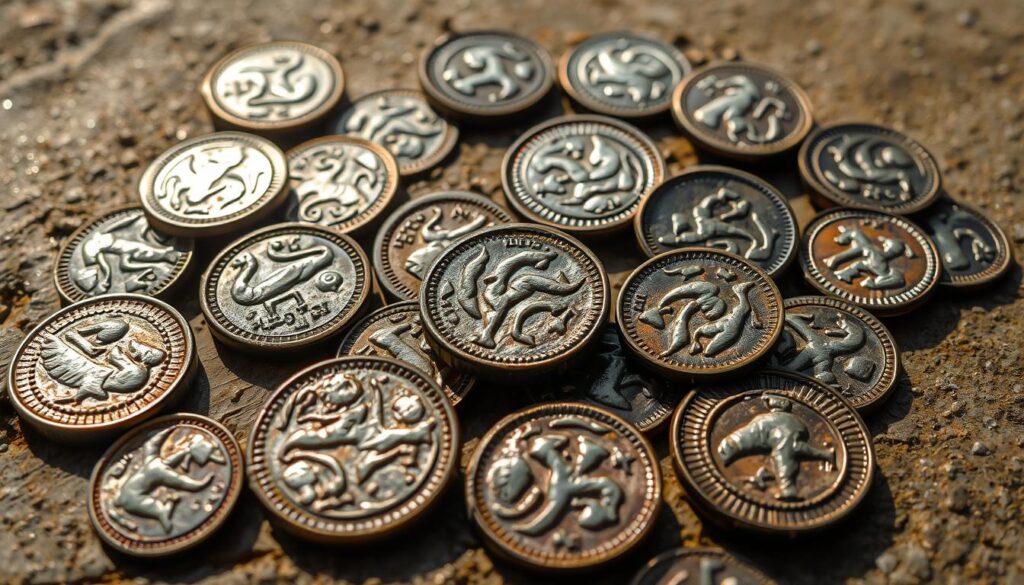
The Evolution of Money Through Ancient Civilizations
The history of money spans thousands of years, shaped by the ingenuity of ancient civilizations. In Mesopotamia, barley was used as currency around 3000 BCE, while Greek city-states introduced sophisticated coinage systems during the Classical period.
Cowrie shells, one of the earliest known currencies, were used in China around 1200 BCE and later adopted across parts of Africa until the mid-20th century. By 1000 BCE, China began producing standardized metal coins, including bronze and copper imitations of cowries.
The first modern coins appeared around 500 BCE outside China, featuring stamped images of gods and emperors to signify authenticity. This innovation spread widely across Europe and the Middle East during the Hellenistic period, driven by Greek cultural influence.
By 118 BCE, leather money in the form of white deerskin pieces was used in China, possibly the earliest banknotes. Paper banknotes followed in 806 CE, gaining popularity until their value declined in the 15th century.
Meanwhile, in North America, wampum—beads crafted from clam shells—became currency for Native American tribes by 1535. These varied forms of money illustrate the creativity and adaptability of societies in developing systems to facilitate trade and economic growth.
From shells to coins, leather to paper, each innovation reflects humanity’s evolving needs and resourcefulness in shaping monetary systems.
| Timeline | Significant Developments in Historical Currencies |
|---|---|
| 1200 B.C. | Cowrie shells used as a medium of exchange in China |
| 1000 B.C. | Metal money and coins, including bronze and copper cowrie imitations, first manufactured in China |
| 500 B.C. | First modern coinage with round coins and images of gods and emperors developed outside of China |
| 118 B.C. | Leather money in the form of white deerskin pieces used in China, possibly the earliest known form of banknote |
| 806 | First paper banknotes appeared in China, widely used for 500 years until value depreciation and inflation in the 15th century |
| 1535 | Wampum, strings of beads made from clam shells, used as a form of currency by North American Indians |
The Transition to Paper Currency
Paper currency has a rich history, tracing its origins back to ancient China. During the Tang dynasty (618-907 AD), Chinese merchants sought to avoid the hassle of carrying bulky coins and instead turned to promissory notes, marking the birth of paper money. This innovation gained widespread traction under the Song dynasty (960-1279 AD), as paper money was used alongside traditional coins.
In Europe, the precursor to modern banknotes emerged in medieval Italy and Flanders, where promissory notes became increasingly common. The Bank of England, established in 1694, marked a turning point by issuing permanent banknotes, transforming monetary systems forever.
The transition to paper money was driven by the need for more efficient financial innovation and monetary policy. Banknotes offered a more convenient alternative to carrying heavy banknotes and facilitated the growth of trade and commerce. This shift paved the way for the development of modern banking systems and the widespread use of fiat currency.
“In 1861, the Act of July 17 permitted the Treasury Department to start printing and circulating paper money to finance the Civil War, resulting in the issuance of the first government-issued ‘greenbacks.'”
The emergence of paper currency marked a significant milestone in the history of money, transforming how individuals and economies conducted financial transactions. This transition laid the groundwork for the modern banking system and the global dominance of fiat currency, paving the way for further advancements in financial innovation and monetary policy.
The Gold Standard Era and Its Impact
The gold standard, a monetary system established in the 1870s, linked currency values to a fixed amount of gold. This system provided stability in international trade and exchange rates, but it also limited governments’ ability to manage economic stability through monetary policy. The constraints of the gold standard led many countries to abandon it after World War I, paving the way for more flexible financial systems.
The gold standard system was officially adopted by England in 1819, with the United States following suit in 1900. The Bretton Woods Agreement of 1944 established the U.S. dollar as the dominant reserve currency, convertible to gold at a fixed rate of $35 per ounce. However, this era came to an end in 1971 when President Nixon terminated the convertibility of the U.S. dollar to gold, marking the end of the gold standard.
The adoption of the gold standard led to a peak in international trade settlement using physical gold between 1871 and 1914. However, the system also had its challenges, with the stock market crash of 1929 causing many countries to suspend the gold standard, starting with England in 1931. In 1934, the U.S. government revalued gold from $20.67 to $35 per ounce to improve its economy, leading to a dramatic devaluation of the dollar and a rise in gold production.
| Key Metrics | Gold Standard Era | Post-WWII Era |
|---|---|---|
| Average Annual Inflation Rate | 0.1% | 4.1% |
| Coefficient of Variation for Price Instability | 17.0 | 0.4 |
| Average Unemployment Rate | 6.8% | 5.9% |
| Resource Cost for Maintaining Gold Standard | Over 2.5% of GDP | N/A |
The gold standard system effectively operated as a “commitment” mechanism, ensuring policymakers maintained a commitment to price stability. However, it also limited their ability to respond to economic crises through monetary policy. The transition away from the gold standard paved the way for more flexible financial systems and the rise of fiat currency.
“The gold standard effectively operated as a ‘commitment’ mechanism ensuring policy makers maintained a commitment to price stability.”
Modern Banking Systems and Fiat Currency
The transition to fiat money marked a significant shift in monetary systems. Unlike commodity-backed currencies, fiat money derives its value from government decree and public trust. This change allowed for greater flexibility in monetary policy and economic management. Modern central banks now play a crucial role in controlling money supply, interest rates, and overall economic stability.
The digitalization of financial systems has prompted the development of Central Bank Digital Currencies (CBDCs), which aim to provide enhanced control over the money supply and improve monetary policy implementation. CBDCs strive to make financial transactions more accessible, faster, and cheaper, ultimately promoting financial inclusion.
| Country | CBDC Initiative | Status |
|---|---|---|
| Brazil | Drex | Aims to simplify and improve access to financial services and transactions, promoting economic growth |
| The Bahamas | Sand Dollar | One of the first operational CBDCs, introduced in 2020 |
| China | Digital Yuan | Conducting trials to explore the potential benefits of CBDCs |
Cryptocurrencies, such as Bitcoin and Ethereum, have also gained popularity, offering reduced transaction fees, enhanced security, and faster processing times compared to traditional banking systems. The advent of stablecoins, pegged to existing currencies or commodities, has addressed the volatility inherent in typical cryptocurrencies.
“The adoption of CBDCs, exemplified by Brazil’s Drex, signifies a shift towards more inclusive, efficient, and secure financial systems.”
The transition from commodity-backed currencies to fiat money systems began in the 20th century, with the Bretton Woods agreement in 1944 and President Nixon’s abolishment of the dollar’s convertibility into gold in 1971. This shift towards fiat money offered increased monetary independence, economic management flexibility, and facilitation of international trade, although it also brought challenges such as inflation risks and dependence on trust.

The Digital Revolution in Money
In the 21st century, the financial landscape has undergone a remarkable transformation, ushering in a new era of digital money. The rise of electronic payments, digital banking, and financial technology has revolutionized how people exchange and manage their funds.
The introduction of mobile payment platforms, such as Apple Pay and apps like Venmo and PayPal, has made transactions faster, more convenient, and often more cost-effective than traditional banking methods. These digital payment solutions have paved the way for a cashless society, where electronic payments are the norm rather than the exception.
Central Bank Digital Currencies (CBDCs) have emerged as a significant development in the digital money revolution. These tokens, serving as digital representations of value, leverage the principles of tokenization and decentralization to meet the growing demands for more efficient and transparent payment systems. CBDCs enable peer-to-peer transactions, offering a resilient payment infrastructure, reducing transaction costs, enhancing information sharing, and facilitating data reconciliation.
The integration of tokenization, decentralization, and secure information sharing through CBDCs presents a host of benefits in reshaping payment relations for retail, wholesale, and cross-border transactions. Central banks across North America, Europe, and Asia have been actively testing and exploring the potential of blockchain-enabled payment solutions, demonstrating progress in scalability and interoperability.
As the digital revolution in money continues to unfold, the adoption of CBDCs will depend on local circumstances and policy objectives, with central banks playing a crucial role in driving collaboration across the financial sector. The success factors for CBDC implementation include security, scalability, privacy considerations, and the convergence of assets and currency on a single ledger.
The digital transformation in money has undoubtedly reshaped the financial landscape, offering unprecedented convenience, efficiency, and transparency. As the world moves towards a more cashless society, the continued evolution of electronic payments, digital banking, and financial technology will undoubtedly shape the future of money.
“The integration of tokenization, decentralization, and secure information sharing through CBDC offers benefits in reshaping payment relations for retail, wholesale, and cross-border transactions.”
The Rise of Cryptocurrency and Blockchain
The world of money has undergone a remarkable transformation in recent years, with the emergence of Bitcoin and other cryptocurrencies. These digital assets, powered by blockchain technology, have disrupted the traditional financial landscape, offering features like lower transaction fees and independence from central authorities.
Bitcoin, the first digital cryptocurrency, was launched in 2009. Since then, the cryptocurrency market has grown exponentially, with over 10,000 different types of digital assets in existence. As of 2024, Bitcoin’s market capitalization reached an impressive $1.14 trillion, highlighting the growing significance of cryptocurrencies and blockchain technology in the global financial system.
- More than 50% of the world’s population is estimated to own a smartphone, indicating a growing potential user base for blockchain technology.
- In 2015, the U.S. Commodity Futures Trading Commission categorized Bitcoin and other virtual currencies as commodities, marking a regulatory milestone.
- Stablecoins, a type of cryptocurrency pegged to stable assets like the U.S. dollar, are being recognized as potentially essential components in decentralized finance (DeFi).
The financial services industry is also taking note of the potential of blockchain technology, with more than 400 banks and financial institutions using it in some form. The transition to digital assets and the rise of decentralized finance pose new challenges for regulators, but also offer opportunities for innovation and greater financial inclusion.
“The rise of cryptocurrencies and blockchain technology represents a fundamental shift in the way we think about money and financial transactions.”
Current Trends in Digital Finance
The financial landscape is rapidly evolving, and the digital revolution has brought about a myriad of innovative trends that are reshaping the future of money.
Central Bank Digital Currencies (CBDCs) are being explored by numerous countries, offering the potential for more efficient, secure, and inclusive financial systems. Decentralized Finance (DeFi) platforms are challenging traditional banking models, providing new avenues for financial transactions and asset management.
The integration of artificial intelligence (AI) and blockchain technology in financial services is particularly noteworthy. AI-powered systems like the “Financial Expert Interpreter Agent” and the “Real-Time Investment Information Search Agent” are enhancing decision-making, language interpretation, and data analysis capabilities for financial institutions. Meanwhile, blockchain technology is aiming to reduce transaction costs and increase efficiency by eliminating intermediaries in the digital payments sector.
Mobile payments have also seen a surge in adoption, with platforms like Apple Pay, Google Wallet, and Samsung Pay facilitating transactions from smartphones. Near Field Communication (NFC) and biometric authentication technologies in these mobile payment systems have reduced the risk of fraud and enhanced security.
The rise of cryptocurrencies, such as Bitcoin, has introduced faster and more cost-effective transactions with reduced intermediaries. Additionally, e-wallets like PayPal, Venmo, and Alipay have provided convenient options for managing finances, with features like instant transfers and loyalty rewards.
As the digital finance landscape continues to evolve, the integration of emerging technologies like AI, biometrics, and blockchain is expected to further enhance the security, convenience, and efficiency of financial transactions. The future of money is undoubtedly digital, and these innovative fintech innovations and digital currencies are shaping the future of money and economic forecasts.
“The financial world continues to evolve with emerging trends in digital finance, promising more efficient, secure, and inclusive financial systems for the future.”
Conclusion
The remarkable journey of money, from primitive barter systems to the digital age of cryptocurrency, reflects humanity’s unwavering pursuit of more efficient and adaptable means of exchange. This evolution, spanning millennia, has been shaped by the changing economic, social, and technological landscape, showcasing our ingenuity and resilience in the face of emerging challenges.
As we look towards the future, the convergence of finance and technology promises further innovations in how we perceive, use, and manage money. The rise of digital currencies, blockchain technology, and mobile payment platforms has the potential to revolutionize the global economy, fostering greater financial inclusion, transparency, and security.
Understanding the historical trajectory of monetary evolution is crucial for navigating the complex and rapidly changing landscape of global finance. By embracing the lessons of the past and the possibilities of the future, we can better prepare for the economic realities that lie ahead, empowering individuals, businesses, and nations to thrive in the dynamic world of finance and commerce.
FAQ
What is the history of money?
Money has been part of human history for at least 5,000 years, evolving from barter systems to modern digital currencies. It has served three primary functions: medium of exchange, store of value, and unit of account.
What were the limitations of barter trade?
Barter trade faced significant challenges in larger economies, including the need for a mutual desire for each other’s goods, lack of a standard unit of value, and difficulty in storing wealth.
How did commodity money emerge as a solution?
Commodity money, such as livestock, grains, spices, and salt, provided a more standardized unit of account and store of value, facilitating easier trade and wealth accumulation.
When and where were the first standardized coins minted?
The world’s oldest known coin minting site was discovered in Guanzhuang, China, dating back to around 640 BCE, and Lydia’s King Alyattes minted the first official currency, the Lydian stater, in 600 BCE.
How did ancient civilizations contribute to the evolution of money?
Ancient civilizations, such as Mesopotamia, Greece, and China, played a significant role in the development of monetary systems, including the use of barley, sophisticated coinage, and the emergence of paper currency.
What was the impact of the gold standard?
The gold standard, established in the 1870s, linked currency values to a fixed amount of gold, providing stability in international trade and exchange rates, but also limiting governments’ ability to manage economic crises through monetary policy.
How did the transition to fiat money change monetary systems?
The shift to fiat money, which derives its value from government decree and public trust, allowed for greater flexibility in monetary policy and economic management, with modern central banks playing a crucial role.
What are the key developments in digital money?
The 21st century has seen the rise of mobile payments, digital wallets, and cryptocurrencies, which have revolutionized transactions and the way we interact with money, promising more efficient, secure, and inclusive financial systems.
