
Why Railway Tokens Became Valuable Clues Across Old Rail Networks
Anúncios
Railway Tokens served as the physical backbone of single-track train safety long before digital signaling systems existed, turning simple brass discs and steel staffs into indispensable historical artifacts today.
When railway historians, industrial archaeologists, and museum curators examine abandoned corridors across Britain, Australia, India, and the Americas, these stamped metal objects reveal operational truths that paper timetables rarely preserve.
A single engraved code on a weathered bronze tablet confirms which exact branch line remained active during economic downturns, how stationmasters coordinated emergency freight movements, and where forgotten junctions once connected isolated rural communities to national trade routes.
Because every token required precise physical matching with trackside mechanical instruments, each surviving piece acts as an incorruptible witness to nineteenth- and twentieth-century transport engineering.
Modern researchers treat these artifacts not merely as collector curiosities, but as primary forensic records capable of reconstructing lost infrastructure with remarkable precision.
Anúncios
What You Will Discover in This Guide
- How physical token instruments prevented catastrophic head-on collisions on single-track rail corridors.
- Why specific engravings, alloy compositions, and wear patterns allow historians to map abandoned stations and track realignments.
- Which real-world railway museums and archival organizations authenticate these historical signaling artifacts today.
- How comparative token designs evolved across different eras of mechanical and electric block signaling.
How Did Mechanical Token Systems Protect Single-Track Railways?
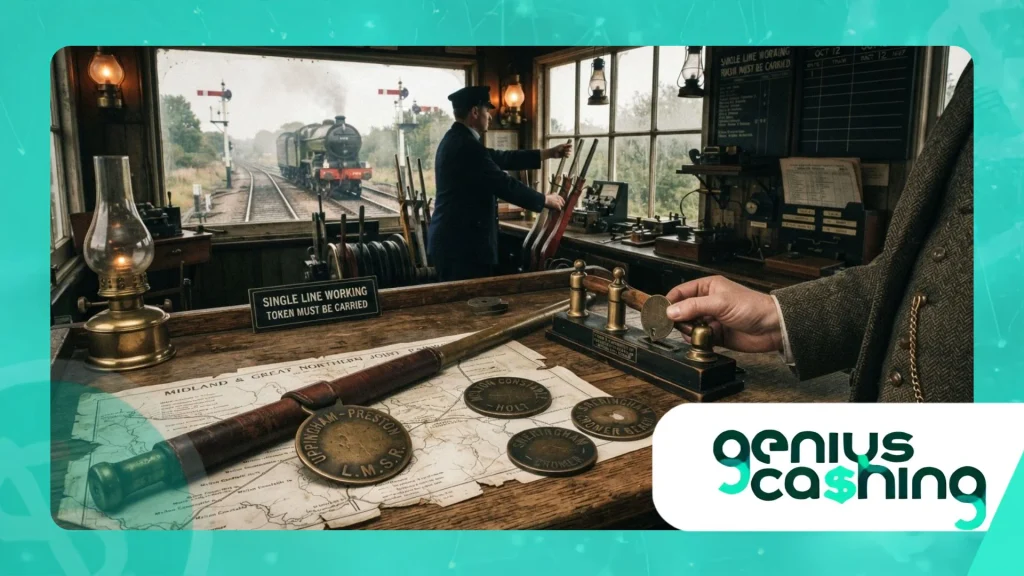
What Problem Did Early Single-Line Railways Face Without Digital Signals?
Single-track railway lines offered immense financial savings during the rapid rail expansion of the nineteenth century, yet they created an immediate and deadly operational hazard.
Two trains traveling in opposite directions could easily enter the same stretch of single track if telegraph messages suffered delays or stationmasters misunderstood handwritten dispatch orders.
Early railway engineers realized that relying purely on human memory or printed schedules invited devastating head-on collisions whenever bad weather or mechanical breakdowns disrupted normal timetables.
To eliminate this lethal vulnerability, Victorian inventors introduced the radical principle that no locomotive driver could legally enter a single-track section without holding a unique physical object.
If only one physical token existed for a specific block section between Station A and Station B, two trains could never occupy that track simultaneously under normal operating rules.
This tangible guarantee transformed railway safety overnight and established the foundational logic behind physical Railway Tokens across global rail networks.
How Did the Electric Train Staff and Tablet Instruments Work?
Engineers Edward Tyer and William Thomson revolutionized single-line operations during the late nineteenth century by linking physical tokens to synchronized electromagnetic machines at opposite ends of a track section.
Stationmasters placed a batch of identical metal tablets or staffs inside locked cast-iron instruments connected by an overhead telegraph wire.
When a signalman at the western station needed to dispatch a train, he pressed a plunger to request an electrical release from his colleague at the eastern station.
Once the receiving signalman confirmed the line was clear and held down his release key, an electric current unlocked exactly one token from the sending machine.
Both instruments immediately locked themselves automatically, making it mechanically impossible to extract a second token until the train arrived at the destination station and the driver surrendered the artifact into the receiving machine.
Even if a storm severed the telegraph wires, both machines remained securely locked in a fail-safe state until maintenance crews restored electrical continuity.
++ The Curious Case of Money Printed for Places That Never Existed
Why Could Drivers Never Enter a Section Without Physical Authorization?
Strict railway rulebooks across the British Empire and Commonwealth nations treated the physical possession of the token as the supreme authority over any colored semaphore signal or verbal instruction.
A driver approaching a starting signal had to physically observe the signalman holding the designated staff or tablet inside a large cane hoop before accelerating onto the single line.
If the driver noticed a discrepancy in the engraved station names or color coding, regulations compelled him to stop the train immediately and report a critical safety breach.
At high-speed express junctions, firemen leaned out from the locomotive cab to snatch the cane hoop from a trackside exchange post while dropping off the previous section’s token simultaneously.
This dramatic mechanical choreography left distinct dents, scratches, and metal fatigue marks on surviving tokens that modern researchers analyze to determine train speeds and traffic density.
Every physical scar on the metal confirms how frequently heavy freight or passenger expresses traversed that specific corridor.
Why Do Historians Treat Railway Tokens as Forensic Clues?
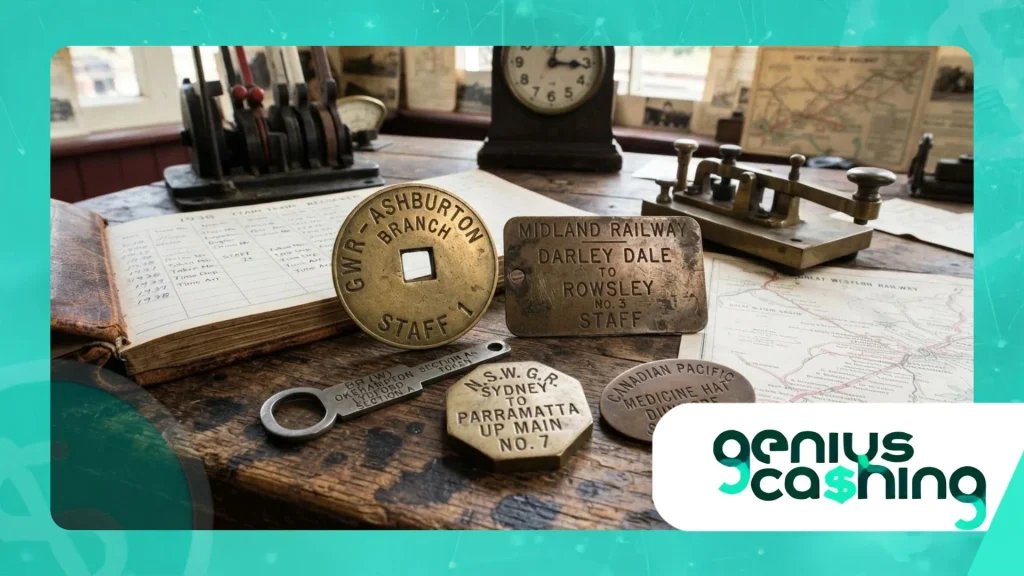
What Information Do Engraved Codes and Serial Numbers Reveal?
Every authentic signaling token carries crisp stamped inscriptions identifying the exact names of the two bounding stations, the sequential block number, and the specific configuration class of the locking mechanism.
When paper station ledgers perished in fires or corporate mergers, surviving Railway Tokens frequently provided the sole surviving proof that a remote siding or temporary wartime halt ever operated.
Historians cross-reference these stamped station pairings against old Ordnance Survey maps to pinpoint where long-dismantled passing loops once stood.
Serial numbers stamped onto the rim or face of a tablet also tell researchers how many tokens originally circulated within a particular instrument pair.
Because Tyer tablet machines typically held between twenty and thirty tablets per section, discovering a tablet stamped with a high serial number indicates heavy, continuous traffic requiring frequent one-way dispatches.
Conversely, a wooden or brass staff engraved without a series number reveals a low-traffic branch line where a single shuttle locomotive simply traveled back and forth all day.
++ How Forgotten Banknote Plates Helped Expose Counterfeit Schemes
How Do Alloy Choices and Wear Patterns Expose Hidden Operational History?
Metallurgical analysis of surviving tokens uncovers fascinating economic and geopolitical pressures that shaped historical railway operations.
During standard peacetime manufacturing, foundries cast tablets from durable brass, bronze, or gunmetal alloys designed to resist corrosion inside damp signal boxes.
However, tokens produced during World War I and World War II often display lighter aluminum compositions or recycled steel substitutes because military munitions factories claimed priority over copper and tin supplies.
Surface wear patterns further act like fingerprints of daily railway labor across decades of continuous service.
Deeply worn edges around the central hole of a Tyer tablet demonstrate thousands of high-speed exchanges using leather pouches and trackside mechanical catchers.
By comparing the erosion depth on two tokens from adjacent track sections, industrial archaeologists can reconstruct which route carried the heaviest mineral exports and which branch gradually declined into obscurity.
Also read: The Most Expensive Business Handshake Ever Recorded
How Have Museums and Researchers Used Tokens to Map Lost Networks?
Curators at the National Railway Museum in York, United Kingdom, maintain extensive reference collections of block signaling instruments and physical tokens to document Britain’s pre-Beeching rail network.
According to archival cataloging records from the National Railway Museum, hundreds of closed rural branch lines across England, Scotland, and Wales are represented in public collections primarily through their surviving brass tablets and wooden train staffs.
Researchers regularly examine these holdings to verify exact route closures and track remodeling dates that corporate minute books recorded inaccurately.
Consider a practical example from a disused colliery branch in South Wales where subsidence forced engineers to relocate a signal box three times over forty years.
While local newspaper archives only mentioned general track repairs, three surviving Railway Tokens from that corridor displayed slightly altered station suffixes and updated configuration notches.
Those subtle physical modifications allowed transport historians to date each exact realignment of the colliery junction down to the specific decade.
Another compelling example emerges from regional rail networks in Victoria, Australia, where broad-gauge rural lines relied heavily on miniature electric train staffs well into the late twentieth century.
When heritage preservation groups surveyed an abandoned wheat-belt line, they uncovered an undocumented intermediate crossing loop solely because a local collector possessed a staff engraved with an unfamiliar siding name.
That single piece of stamped steel prompted an archaeological field survey that successfully located the buried brick foundations of the forgotten signal cabin.
How Did Token Designs Evolve Across Different Rail Eras?
What Distinguished Early Wooden Staffs from Brass Tablets?
The earliest single-line safety systems deployed simple turned wooden staffs painted in bright, distinct colors such as red, white, or blue to differentiate adjacent track sections at a glance.
While completely foolproof against double-occupancy accidents, a single wooden staff created severe operational bottlenecks whenever two trains needed to travel in the same direction consecutively.
Stationmasters solved this limitation temporarily by introducing the “staff and ticket” system, where the staff unlocked a wooden box containing paper tickets for following trains, while the last train in the convoy carried the actual staff.
Edward Tyer overcame that directional bottleneck in 1878 by inventing flat circular metal tablets roughly four and a half inches in diameter.
Because dozens of interchangeable tablets sat locked inside paired electromagnetic machines, signalmen could dispatch multiple trains in the same direction one after another without waiting for a return train.
Each tablet featured unique perimeter notches or central cutouts that physically prevented a driver from inserting a tablet from Section A into the machine governing Section B.
Why Did Miniature Electric Train Staffs Replace Bulky Tablets?
As locomotive speeds increased during the early twentieth century, firemen struggled to safely catch heavy circular tablets inside bulky leather pouches without risking hand injuries.
To solve this ergonomic danger, the Railway Signal Company introduced the Webb and Thompson electric train staff, followed later by the streamlined miniature electric train staff.
These cylindrical steel rods weighed significantly less than early cast-iron staffs and slipped effortlessly into spring-loaded trackside exchange apparatus.
Machinists cut precision rings and grooves along the shaft of each miniature staff so that only staffs belonging to that exact section could pass through the keyhole slot of the paired instrument.
Think of a single-track railway corridor like a narrow one-lane mountain bridge guarded by a single physical brass key; no driver dares cross the span unless that exact key rests visibly inside their cab, guaranteeing absolute right-of-way over oncoming traffic.
That simple mechanical certainty made miniature staffs the gold standard across Britain, India, Sri Lanka, and Australia for nearly a century.
Where Do Physical Token Systems Still Operate Today?
Although centralized traffic control, axle counters, and radio-based electronic block systems dominate modern mainlines, physical token instruments have not vanished entirely in 2026.
Several heritage railways in the United Kingdom, including the Severn Valley Railway and the North Yorkshire Moors Railway, operate authentic Victorian tablet and miniature staff instruments daily to train volunteers and preserve living industrial heritage.
Moreover, a handful of lightly trafficked rural rail corridors in parts of South Asia and regional freight branches still utilize modernized tokenless or key-token interlocking derivatives because mechanical reliability requires minimal external power infrastructure.
| Token Type | Primary Era | Typical Material | Core Safety Mechanism | Key Diagnostic Clue for Historians |
| Plain Wooden Staff | 1840s–1870s | Turned hardwood (painted) | Single physical object per section | Color coding and painted station lettering |
| Staff and Ticket Box | 1850s–1890s | Wood and brass key | Master staff unlocks paper ticket box | Surviving brass lock engravings and ticket dates |
| Tyer’s Electric Tablet | 1878–1960s | Brass, bronze, or aluminum | Electromagnetic lock via telegraph line | Perimeter notches, serial numbers, and alloy type |
| Webb & Thompson Staff | 1889–1970s | Steel with brass rings | Annular grooves matched to instrument slot | Ring spacing patterns and heavy catcher wear |
| Miniature Electric Staff | 1905–1990s | Turned steel alloy | Compact slotted shaft for fast exchange | High-speed exchange dents and section codes |
Preserving the Metal Witnesses of Rail History
Every engraved tablet and grooved steel staff rescued from an old signal box preserves a tangible chapter of engineering ingenuity and human accountability.
Before computer microprocessors and satellite positioning monitored train movements across continents, Railway Tokens enforced discipline through pure mechanical truth, ensuring that two trains never claimed the same stretch of single track simultaneously.
Today, those surviving artifacts empower historians, archaeologists, and curious readers to trace forgotten branch lines, decode wartime material shortages, and verify local transport histories that paper records left incomplete.
Have you ever spotted an antique railway tablet or train staff in a local museum or heritage line? Share your discoveries or questions in the comments below to keep these fascinating industrial stories alive.
Frequently Asked Questions
Why could a railway token from one section never work in another station’s machine?
Engineers machined unique notches, holes, or concentric rings onto every token series so each piece acted like a bespoke physical key.
If a signalman attempted to insert a tablet from an adjacent block section into the wrong instrument, internal cast-iron wards physically blocked the slot, preventing the machine from locking or releasing another token.
Are antique railway tokens valuable to historians and collectors today?
Yes, authentic tokens hold substantial historical and curatorial value because each piece documents a specific geographical route and engineering era.
Tokens originating from long-closed branch lines, short-lived industrial spurs, or wartime substitute alloys attract particular interest from transport researchers and railway museums.
What happened if a train driver accidentally carried a token past the destination station?
Carrying a token past its designated boundary constituted a severe operational breach known as “over-carrying.”
Because the receiving instrument remained electrically locked without that exact token, all traffic on that single-track section halted completely until railway officials physically returned the missing artifact to the proper signal box.
How did signalmen exchange railway tokens with express trains moving at high speed?
Signalmen placed the metal tablet or miniature staff inside a leather pouch attached to a large cane or steel hoop, which they hung on a trackside exchange stand.
As the locomotive raced past, a mechanical catcher arm mounted on the cab snatched the hoop while simultaneously depositing the outgoing token into a trackside net.
How can researchers verify whether an old railway token is genuine?
Specialists inspect the crispness of the stamped station typography, verify the exact alloy weight, and match the configuration number against official railway signaling registers.
Authentic artifacts also exhibit natural mechanical wear around exchange edges and slot contact points that modern cast reproductions rarely replicate accurately.
